News Summary
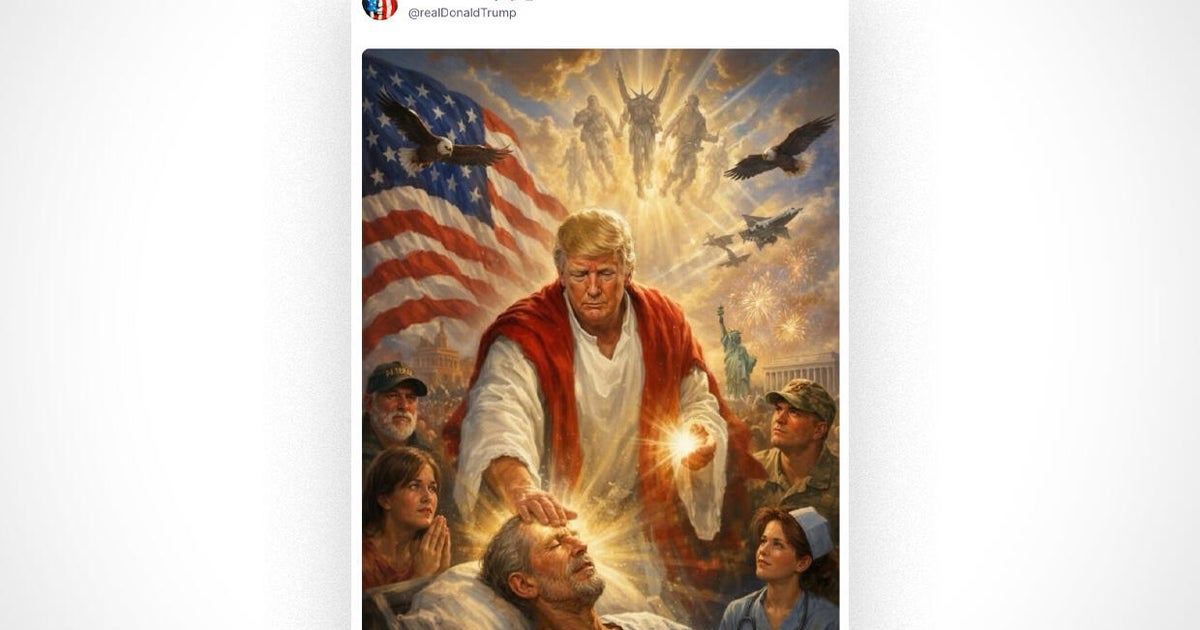
President Trump posted an AI-generated image on his Truth Social account on Sunday night that depicted him in a white robe and red sash, holding a ball of light in one hand and extending the other in a healing gesture, an image resembling traditional depictions of Jesus Christ. The image was a slightly altered version of one previously posted months earlier by right-wing influencer Nick Adams. Trump’s post was made on Orthodox Easter and was deleted from his account late Monday morning. The White House did not comment and Trump had not apologized as of Monday. The post drew criticism from a number of conservative and Christian public figures and some Republican officials, who called the image inappropriate, blasphemous, or politically damaging. The article notes that Adams had written that “President Trump is healing this nation” when he first posted the image, and that Trump appointed Adams in March as a special presidential envoy for American tourism, exceptionalism and values. The article also reports that the post came shortly after another Trump post in which he lashed out at Pope Leo XIV, who has criticized U.S. war efforts in Iran; the pope’s remarks about seeking peace and reconciliation are included in the report.
Biblical Reflection
From a biblical perspective, the use of Christ-like imagery to depict a political leader raises serious spiritual and pastoral concerns. Scripture presents Jesus as unique—Lord, Savior, and the only mediator between God and people—so portraying a temporal ruler in Christ’s likeness can imply a conflation of political power with divine authority, a form of idolatry or misrepresentation of the gospel (Acts 4:12; 1 Timothy 2:5). The public reaction from conservative Christians reflected that concern, and those reactions themselves are a reminder that Christians must protect the integrity of Christ’s person and work even when evaluating leaders they otherwise support. At the same time, Christian response should balance righteous offense with measured charity: call out misuse of sacred symbols and demand humility and repentance where appropriate, but avoid descending into partisan vilification or spectacle. The article’s framing—emphasizing backlash from within the conservative movement—points to an intra-tribal accountability moment rather than a simple left-right media attack; readers should note how religious sentiment is being mobilized both to defend and to criticize a political figure. Ultimately, the incident is a prompt to reaffirm that political allegiance must never supplant worship, and to press leaders to exercise humility rather than self-exaltation.
Scripture in context
This outlook does not yet include contextual Scripture citations. Do not treat a general biblical theme as an exegetical conclusion.
Faithful Response
No prescribed response is offered. Consider the reflection prompts below in your own church context.
Reflection and Discussion
- 1Does this portrayal of a political leader as Christ align with biblical teaching about who Jesus is and how Christians are to view earthly authority?
- 2Who benefits from religious imagery being used for political purposes, and what motives or narratives might be driving its circulation?
- 3How should Christians hold leaders accountable when political action or public messaging appears to appropriate sacred symbols?
Sources
Reporting links are evidence inputs; Sanctuary News' biblical reflection is commentary.
This outlook currently relies on fewer than two linked sources. Broaden verification before teaching from it.
- 1.Original reportprimary