News Summary
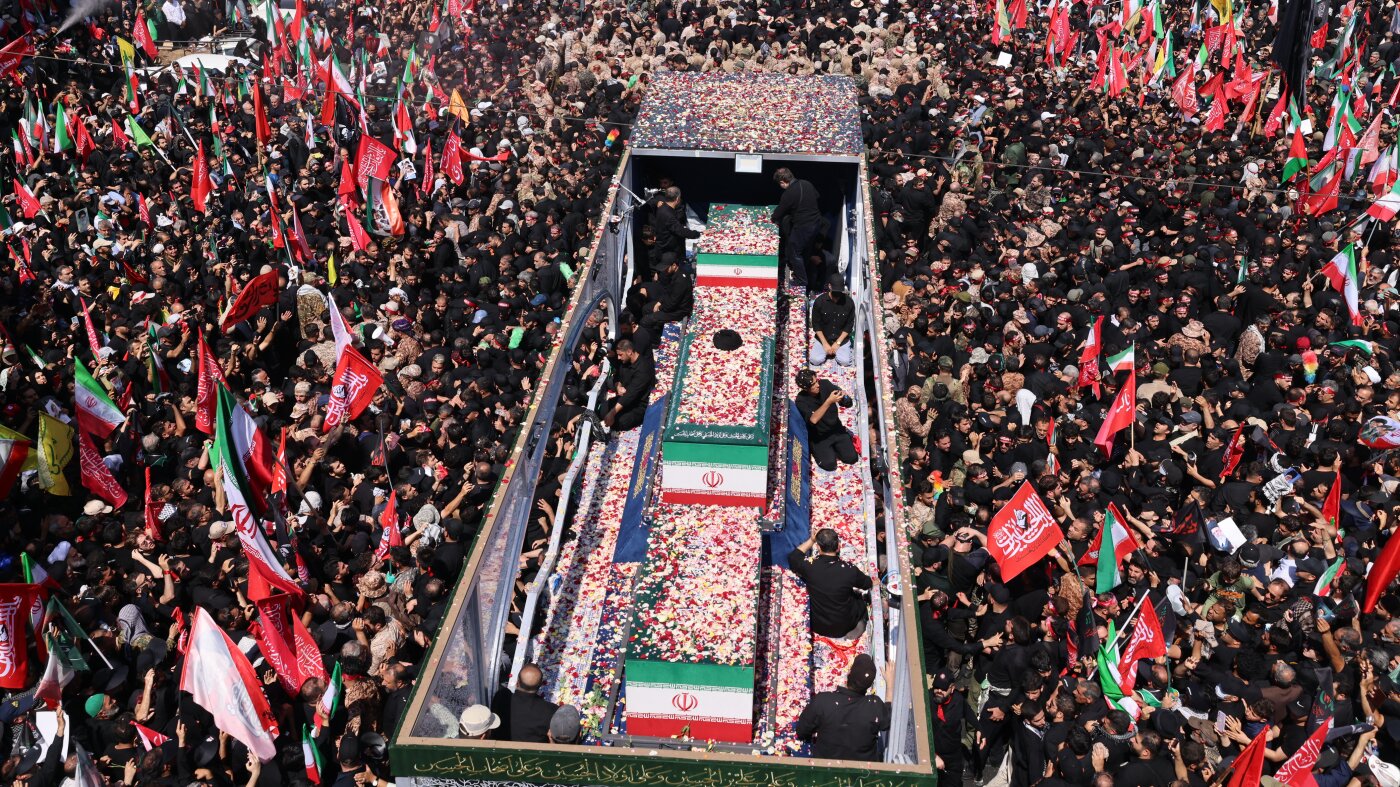
Iran held funeral ceremonies and a public procession in Tehran for Ayatollah Ali Khamenei and four family members more than four months after they were killed on Feb. 28 in strikes attributed to Israel and the U.S. State media showed the flag-draped caskets placed on a semitrailer as large crowds gathered, some weeping and throwing flowers while others chanted anti-American slogans and displayed red flags symbolizing revenge and yellow Hezbollah flags. Iranian officials and some foreign delegations attended lying-in-state ceremonies; named attendees included former Russian president Dmitry Medvedev, Pakistan’s prime minister Shehbaz Sharif, the president of Iraq, the Afghan foreign minister, and a Hamas delegation, and a Saudi delegation was reported present. Iranian leaders said the ceremonies were delayed because of wartime conditions. A Yale scholar quoted in the article said the regime sought to project resilience and continuity. The article notes dissenting voices inside Iran who criticize spending on the ceremonies and who say Khamenei’s rule caused repression; it cites a human rights group’s figure that security forces killed more than 6,000 people during nationwide anti-government protests that began in December 2025. The procession is planned to travel to Qom, cross into Iraq to Shia holy sites in Najaf and Karbala, and then return to Iran for burial in Mashhad, with officials expecting millions to attend.
Biblical Reflection
This report presents a mix of observable facts (the procession, visitors, slogans) and quoted interpretation (scholars, dissidents). The article shows how public mourning can be both genuine grief and a political ritual: states often use funerals to signal continuity, legitimize power, and rally supporters. Christians should be attentive to both sides — the real sorrow of mourners and the way ritual can be instrumentalized to stoke vengeance or silence dissent. The article also surfaces disturbing moral claims: reported state violence against protestors and public calls for revenge and violence in the crowd require sober judgment. Gospel-shaped response calls for truth (acknowledging victims and abuses), mercy (compassion for the grieving and for the vulnerable), and peacemaking (rejecting calls for revenge and public dehumanization). Readers should note the article’s sources — state media coverage, a scholar’s analysis, and anonymous dissenting Iranians — and discern the limits and possible biases of each: state accounts emphasize unity and legitimacy, while dissidents emphasize repression, and outside commentators interpret motive and effect. A faithful Christian stance resists being drawn into triumphalism or retributive rhetoric and instead prays for justice, protection for the vulnerable, and conversion of hearts toward peace.
Scripture in context
This outlook does not yet include contextual Scripture citations. Do not treat a general biblical theme as an exegetical conclusion.
Faithful Response
No prescribed response is offered. Consider the reflection prompts below in your own church context.
Reflection and Discussion
- 1Which voices are amplified or muted in this coverage — state officials, foreign delegations, everyday mourners, and dissenters — and how does that shape our understanding?
- 2How does the public performance of grief function as political messaging, and how should Christians weigh ritual emotion against documented reports of injustice?
- 3When media report chants or calls for revenge, how can we hold together compassion for ordinary mourners and firm opposition to rhetoric that endorses violence?
Sources
Reporting links are evidence inputs; Sanctuary News' biblical reflection is commentary.
This outlook currently relies on fewer than two linked sources. Broaden verification before teaching from it.
- 1.Original reportprimary