News Summary
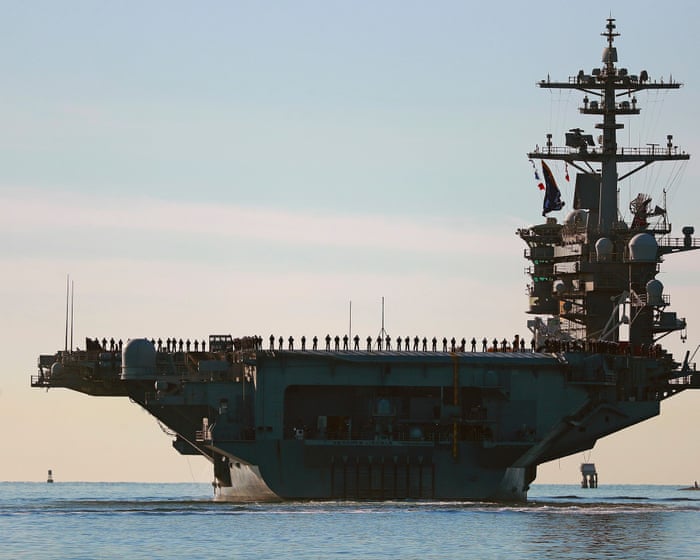
At a White House press availability, President Donald Trump disputed reporting that the aircraft carrier USS Abraham Lincoln experienced deteriorating living conditions during a prolonged deployment in the Strait of Hormuz. According to The Guardian account in this cluster, the president said he had ‘third‑hand reports’ the carrier is “beautifully maintained,” called the media coverage “fake news,” and told a CNN reporter to “be quiet” while berating her. The article situates the exchange against earlier reporting of poor conditions but does not itself supply the underlying first‑hand testimony, Navy responses, or documentary evidence for those prior reports.
Source and Framing Analysis
Source: The Guardian article supplied by the cluster. What it reports: direct quotations attributed to the president (including “beautifully maintained,” “fake news,” and “be quiet”) and the description that he ‘berated’ or ‘snapped at’ a reporter. Framing: the piece frames the exchange as confrontational and places the president’s rebuttal in tension with previously published accounts of deteriorating conditions aboard the USS Abraham Lincoln. Limitations and uncertainties: the supplied article references ‘extensive accounts’ of poor shipboard conditions but does not include those primary accounts, named sailor testimony, Navy statements, maintenance records, or independent inspections in this package. The president’s claim is described as based on ‘third‑hand’ information; the origin and credibility of that information are not documented here. Readers should treat the article as reliable for recording the president’s public words and demeanor as reported, while recognizing it is a single outlet’s report and that the central factual dispute (actual conditions aboard the carrier) remains under‑documented in the supplied text. Additional sources needed for firm conclusions include official Navy comment, first‑person sailor testimony, independent inspections or maintenance logs, and statements from the reporter or CNN.
How sources covered this story
Sanctuary separately assesses reporting quality and alignment with Christian virtues. The virtues assessment considers truthfulness, dignity, compassion, justice, peacemaking, humility, and care for vulnerable people. It does not assess a publisher's faith or reward religious language.
Compare 1 reports
Reporting 75/100Virtues 75/100
- Distinctive contribution
- Provides the President’s own words (saying the carrier is “beautifully maintained,” invoking “third‑hand reports,” and telling a CNN reporter to “be quiet”), and frames his response as a direct rebuttal to prior reporting of deteriorating conditions.
- Framing
- Frames the incident as a confrontation and as the President dismissing criticism; language such as “dismisses,” “snaps,” and “berated” casts the remarks as adversarial and presents the President’s statements in tension with previously reported accounts of poor conditions.
- Omissions or uncertainty
- Does not identify or cite the ‘extensive accounts’ alleging poor conditions, nor does it quote or summarize those reports. Lacks independent sourcing or evidence for the President’s claim (e.g., who made the ‘third‑hand’ reports), and provides no response from Navy officials or the CNN reporter beyond the President’s remarks. Timing, scope, and factual details about the carrier’s condition are absent.
- Why these scores
- Concise, attributes statements clearly to the President, and includes direct quotes that document behavior. The excerpt responsibly signals a contradiction with other reports, but it lacks sourcing or detail about those prior reports and offers limited corroboration beyond the President’s own statements—appropriate for a brief news item but not a deep investigation. The excerpt reports the President’s words and conduct without dehumanizing language, preserves the dignity of involved parties by attributing statements, and does not exploit suffering. It is critical in tone but stays within normal journalistic scrutiny; however, it does not provide additional context or remedies that would reflect stronger compassion or peacemaking.
Biblical Reflection
Christian response must distinguish factual verification from moral judgment. Facts: verify conditions aboard the carrier through credible evidence before assigning institutional culpability. Moral stance: prioritize care for vulnerable persons (sailors and their families), insist on truthful public accounting, and practice speech that protects dignity. Public leaders’ language shapes civic norms; Christians should call for accountability that promotes justice and repair rather than escalating personal humiliation. Pursue truth with humility, seek mercy for the harmed, and press institutions to act justly on verified concerns.
Scripture in context
- 1Ephesians 4:15 (theme) — Paul instructs the community to grow in maturity by speaking truth but doing so in a manner that builds up the body rather than tearing it down. — Public correction and accountability should aim to protect and restore, not to humiliate; truth-telling ought to be coupled with concern for those harmed by circumstances and by rhetoric.
- 2Micah 6:8 (theme) — The prophetic call to act justly, love mercy, and walk humbly with God. — Advocating for fair living conditions and transparent oversight of institutions that care for service members expresses justice and mercy; humility tempers how advocates speak about leaders and opponents.
- 3James 3 (theme) — Teaching about the power of the tongue and the need for restraint in speech. — Christians should model speech that seeks truth but resists demeaning or inflammatory language, especially when discussing people under stress or authority figures whose words shape public life.
Faithful Response
Pray for sailors aboard the USS Abraham Lincoln, their families, and those responsible for their welfare; pray for discernment for journalists, leaders, and the public.
Seek reliable information before drawing firm conclusions: request or review Navy statements, first‑hand sailor testimony, independent inspections, or maintenance records where available.
If credible concerns persist, encourage accountable processes: contact congressional offices, veterans’ advocates, or oversight bodies to request briefings or inspections rather than relying solely on partisan channels.
Model Christlike public speech in personal and congregational conversations—prioritize accuracy, avoid dehumanizing language, and focus on constructive action to aid those harmed.
Provide pastoral care for military and veteran congregants: offer listening spaces, help navigate reporting channels for workplace concerns, and connect affected families with available support resources.
Reflection and Discussion
- 1What standards of evidence should we require before publicly affirming or denying reports of harm to vulnerable people?
- 2How can Christians call for accountability while avoiding language that humiliates or dehumanizes real people?
- 3When leaders disparage journalists, how should the church balance respect for authority with the need to protect the vulnerable and insist on transparency?
- 4What concrete steps can a congregation take to support service members and their families independently of political allegiance?
Sources
Reporting links are evidence inputs; Sanctuary News' biblical reflection is commentary.
This outlook currently relies on fewer than two linked sources. Broaden verification before teaching from it.
Download source notes