News Summary
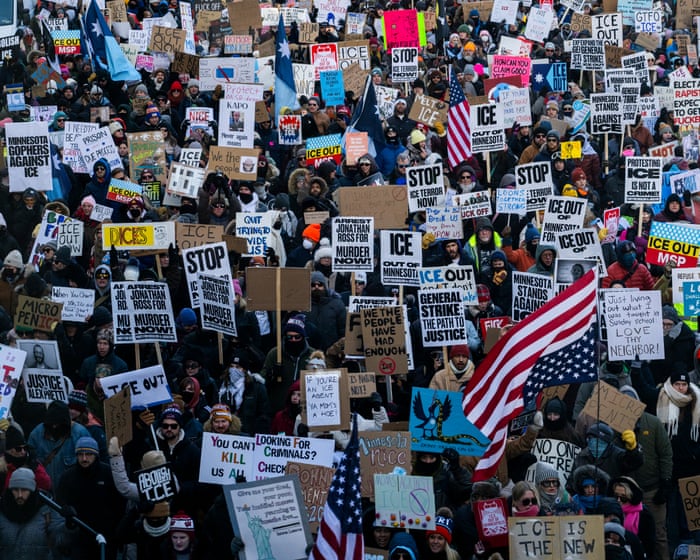
The Guardian published newly disclosed internal Department of Homeland Security (DHS) investigative records indicating DHS deployed undercover agents to community meetings in the Twin Cities and New York, infiltrated Signal group chats, and obtained financial records belonging to mainstream unions and left‑leaning nonprofit organizations as part of an operation directed at groups opposing an immigration enforcement action in Minnesota earlier in 2026. The account rests on the documents disclosed to The Guardian; the article does not include a public DHS confirmation, detailed legal justification, named affected individuals or organizations in full, or independent government documentation within the piece.
Source and Framing Analysis
Source: The Guardian. Framing: the reporting uses strong, critical language (e.g., 'spied on,' 'vast operation') and attributes concrete tactics and locations to 'newly disclosed' internal DHS investigative reports and court documents that the outlet obtained. Strengths: the reporting names specific investigative techniques (undercover attendance at meetings, infiltration of Signal chats, collection of financial records) and geographic points (Twin Cities and New York), which materially advances the factual account. Limitations and uncertainties: the story, as supplied, rests on a single publisher’s access to internal documents rather than on parallel public confirmation; the Guardian excerpts do not present a publicly available DHS statement or alternative official account within the piece; they omit precise dates, scale (how many meetings/chats/records), the identities of the specific unions/nonprofits or individuals targeted, the legal authorities invoked, oversight or inspector‑general findings, and any outcomes (arrests, prosecutions, or corrective actions). Because of those gaps, the claims are plausibly grounded in the disclosed records made available to the Guardian but remain incomplete on legal context, scope, and official response.
How sources covered this story
Sanctuary separately assesses reporting quality and alignment with Christian virtues. The virtues assessment considers truthfulness, dignity, compassion, justice, peacemaking, humility, and care for vulnerable people. It does not assess a publisher's faith or reward religious language.
Compare 2 reports
Reporting 80/100Virtues 78/100
- Distinctive contribution
- Adds geographic specificity (Twin Cities and New York) and method detail (infiltration of Signal chats) and identifies targets as 'mainstream unions and left-leaning nonprofit groups', expanding on who and where were affected.
- Framing
- Describes the activity as a 'vast operation' into groups opposing an immigration crackdown, emphasizing surveillance of leftwing organizations and protesters opposed to government policy.
- Omissions or uncertainty
- The excerpt omits precise dates, scope (how many agents/records), identities of the named unions/nonprofits, legal bases cited by DHS, any outcomes or remedies, and any direct statements from DHS, the implicated groups, or the courts.
- Why these scores
- The passage attributes claims to 'newly disclosed records' and 'internal investigative reports' and gives method and location details, which demonstrates responsible sourcing in the excerpt. Its limitations are lack of quantification and the absence here of named documents, named sources, or official responses — concerns typical of a short excerpt but not of flawed reporting. The report advances transparency and accountability about potential abuses of power, treats implicated groups as political actors rather than dehumanizing them, and thereby supports justice and truth-telling. The excerpt does not explicitly foreground care for affected individuals, but it responsibly exposes possible harms to civic actors.
Reporting 74/100Virtues 76/100
- Distinctive contribution
- Specifically mentions use of administrative subpoenas to seize financial records and characterizes the inquiry as concerning 'domestic terrorist financing', while emphasizing that peaceful organizers and political opponents were targeted.
- Framing
- Frames the revelations as a sweeping surveillance operation by DHS targeting political opponents and peaceful organizers, presented as newly 'laid bare' by court disclosures; the tone is critical of the extent of government monitoring.
- Omissions or uncertainty
- The excerpt does not specify dates or time span of the surveillance, the number of agents involved, which specific groups or individuals were targeted, what exact records were seized, legal justification or court outcomes, or any response from DHS or other authorities.
- Why these scores
- Clear attribution to 'newly disclosed court documents' and concise summary of major claims; however the supplied text is a short newsletter blurb that lacks detailed sourcing, quantification, named documents or responses, and therefore while credible in attribution is limited in depth and specificity. The piece seeks to hold powerful institutions accountable and avoids dehumanizing language about targets; it centers potential injustice against organizers. It lacks explicit expressions of compassion or remedies but aligns with truth-telling and concern for vulnerable civic actors.
Biblical Reflection
Christians are called to hold together respect for legitimate civil authority and protection of public safety with a commitment to defend the dignity, conscience, and civic space of vulnerable neighbors who speak, organize, and advocate. Scripture reminds the faithful to pray for and submit to governing authorities while also insisting that power be exercised justly. The appropriate Christian posture here is neither reflexive hostility toward every use of investigative power nor uncritical acceptance of opaque surveillance; it is rooted in truth, mercy, justice, peacemaking, humility, and care for those who may be harmed. Practically, that means seeking clear facts and oversight, offering pastoral care to those who feel targeted, advocating for lawful limits on surveillance that protect civic dissent and privacy, and treating public servants as human persons while demanding accountability and transparency.
Scripture in context
This outlook does not yet include contextual Scripture citations. Do not treat a general biblical theme as an exegetical conclusion.
Faithful Response
Pray for clarity, restraint, repentance where appropriate, and protection for those whose organizing or privacy may have been violated.
Encourage or support formal oversight: request inspector‑general review, Congressional inquiry, or public release of the underlying records so claims are adjudicated on documented facts rather than conjecture.
Provide pastoral care and safe listening spaces for activists, immigrants, volunteers, and others who may feel surveilled or exposed; compile referrals to civil‑liberties and public‑interest legal counsel for those with legal concerns.
Advocate nonpartisan safeguards that protect peaceful civic organizing, privacy, and whistleblower channels while acknowledging legitimate public‑safety functions of investigative agencies.
Model humility and mercy in public conversation: avoid demonizing individuals in government, emphasize truthful reporting of facts and evidence, and support institutions of accountability and due process.
Reflection and Discussion
- 1How should Christians balance respect for civil authority with the duty to protect neighbors whose civic speech and organizing may be chilled by surveillance?
- 2What kinds of documented evidence and oversight should we expect before concluding that government conduct amounted to improper surveillance or abuse?
- 3How can congregations offer pastoral care to people who feel targeted or exposed by investigative activity while discouraging fear, rumor, or partisan escalation?
- 4In what ways does protecting privacy and the ability to organize for justice arise from the Christian call to love and defend vulnerable neighbors?
Sources
Reporting links are evidence inputs; Sanctuary News' biblical reflection is commentary.
This outlook currently relies on fewer than two linked sources. Broaden verification before teaching from it.
- 1.US government extensively spied on anti-ICE protesters and leftwing groups, records revealprimary_reporting