News Summary
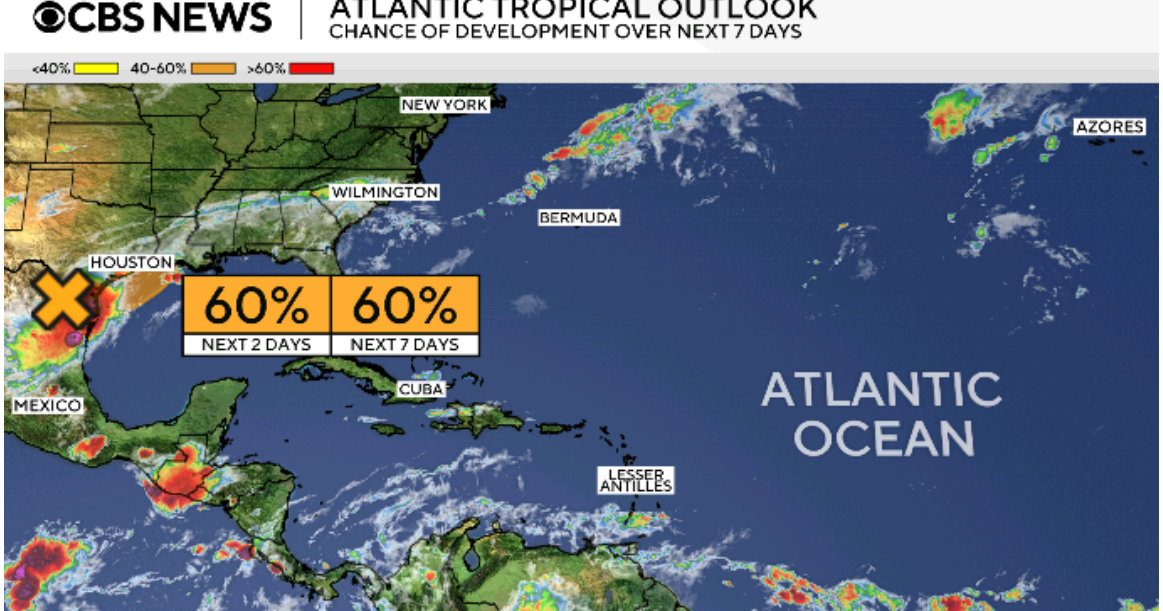
The National Hurricane Center issued a preliminary advisory for "Potential Tropical Cyclone One," a tropical disturbance in the western Gulf of Mexico located between Corpus Christi, Texas, and Lake Charles, Louisiana. As of the advisory the system had northeastward motion and sustained winds near 30 mph, below tropical-storm strength, and lacked a well-defined center. Forecasters said it could intensify and reach tropical-storm-force winds by Wednesday, but emphasized that heavy rainfall and life-threatening flash flooding are the primary hazards regardless of classification. Up to 7–8 additional inches of rain were possible across parts of the South, with some areas already recording historic daily totals in cities including Austin, San Antonio, and Shreveport. A tropical storm watch was issued from Sargent, Texas, to Morgan City, Louisiana. Flood watches and warnings affected large parts of Texas, Louisiana, Mississippi, Alabama and portions of the Florida Panhandle; forecasts flagged the possibility of significant river flooding and prolonged rainfall into the weekend. Several major metropolitan areas, including Dallas, Houston, San Antonio and New Orleans, were expected to see excessive rainfall in the next 48 hours.
Biblical Reflection
This report is primarily technical and premised on expert forecasting; its core intent is public safety rather than persuasion. The National Hurricane Center is the primary source and the article reflects appropriate caution about forecast uncertainty while highlighting immediate hazards. From a Christian perspective, the piece calls us to truth (attend to reliable warnings), humility (recognize our limited control over weather), and mercy (prioritize help for those at risk). The article largely centers meteorological facts and immediate impacts but does not explore longer-term vulnerabilities—such as how poverty, housing, or infrastructure increase harm—or the role of congregations and relief networks. Christians should neither ignore expert warnings nor yield to panic; instead we should be sober-minded, pray for those in danger, advocate for equitable support for vulnerable communities, and be prepared to offer practical assistance through local response and relief efforts.
Scripture in context
This outlook does not yet include contextual Scripture citations. Do not treat a general biblical theme as an exegetical conclusion.
Faithful Response
No prescribed response is offered. Consider the reflection prompts below in your own church context.
Reflection and Discussion
- 1Whose needs and voices are least visible in urgent weather coverage, and how can churches and community groups make sure those people receive help?
- 2How should we hold the tension between trusting scientific warnings and avoiding fear, so that our response is both prudent and rooted in faith?
- 3Does the news focus on immediate forecasts at the expense of conversations about long-term resilience and care for creation that reduce future harm?
Sources
Reporting links are evidence inputs; Sanctuary News' biblical reflection is commentary.
This outlook currently relies on fewer than two linked sources. Broaden verification before teaching from it.
- 1.Original reportprimary