News Summary
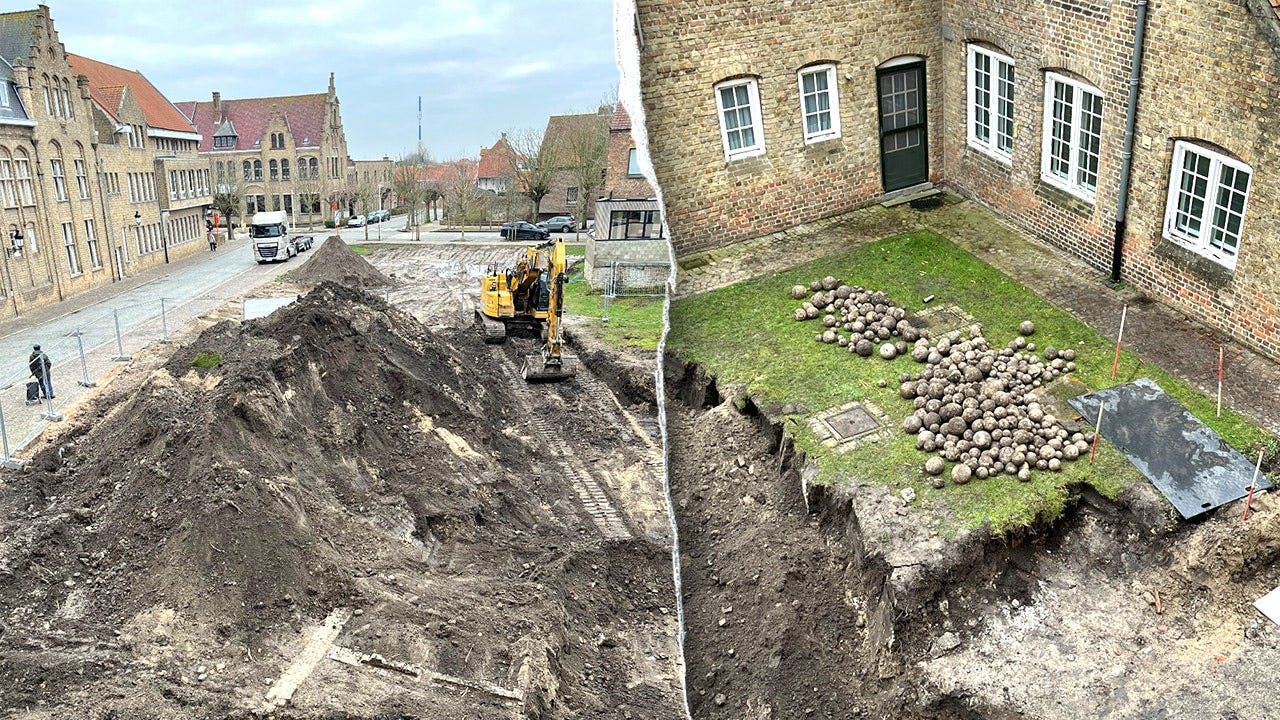
During preparatory excavation for an administrative building in Nieuwpoort, a coastal city in western Belgium, archaeologists uncovered a concentrated cache of roughly 450 stone projectile balls. The finds were photographed in situ and showed dozens of stone balls piled together along with exposed brickwork and preserved soil layers. Initial dating places the balls between about 1350 and 1600 CE. Specialists noted variability in sizes and a high degree of finishing; officials and the excavation team suggested they could have been used with trebuchets or catapults and that some features may indicate later use with firearms, but a definitive function is not yet established. The team also found subsurface traces of medieval structures, wall and floor levels, and an intact World War I shell. Excavation work concluded in early April; the artifacts were removed for laboratory study. City officials and archaeologists described the find as "highly unusual" and stated it may be the first find of this kind in Flanders and possibly more widely. Further analysis, additional dating, and up to two years of study are planned before final conclusions and recommendations (including possible public display) are made.
Biblical Reflection
This discovery is an opportunity for careful, responsible stewardship of the past. The archaeological team and city officials are right to refrain from premature conclusions; describing something as potentially "the first in the world" should be treated as provisional until peer-reviewed analysis is complete. From a Christian perspective, artifacts like these prompt several balanced responses: humility (we stand on the shoulders of many generations), curiosity disciplined by truth-seeking (avoid sensational claims and let the evidence lead), and compassion (remembering that many artifacts of war point to human conflict and suffering). The find also highlights stewardship responsibilities—preserving cultural heritage for the public good rather than exploiting it for headlines or profit. Watch for confirmation bias in reporting (repeating tentative claims as fact), and for narrative framing that emphasizes novelty over context. Pray for historians and archaeologists to have wisdom and integrity in interpretation, and for civic leaders to steward the material in ways that educate and promote reconciliation rather than glorify conflict.
Scripture in context
This outlook does not yet include contextual Scripture citations. Do not treat a general biblical theme as an exegetical conclusion.
Faithful Response
No prescribed response is offered. Consider the reflection prompts below in your own church context.
Reflection and Discussion
- 1What assumptions underlie headlines that call a find "the first in the world," and how should we weigh preliminary claims against the slower work of scientific review?
- 2How does the discovery of weapons or war-related artifacts shape our understanding of past human behavior, and what does Scripture call us to remember about the presence of conflict in human history?
- 3In what ways should civic leaders and churches participate in preserving cultural heritage so it teaches truth and fosters reconciliation rather than feeds sensationalism?
Sources
Reporting links are evidence inputs; Sanctuary News' biblical reflection is commentary.
This outlook currently relies on fewer than two linked sources. Broaden verification before teaching from it.
- 1.Original reportprimary