News Summary
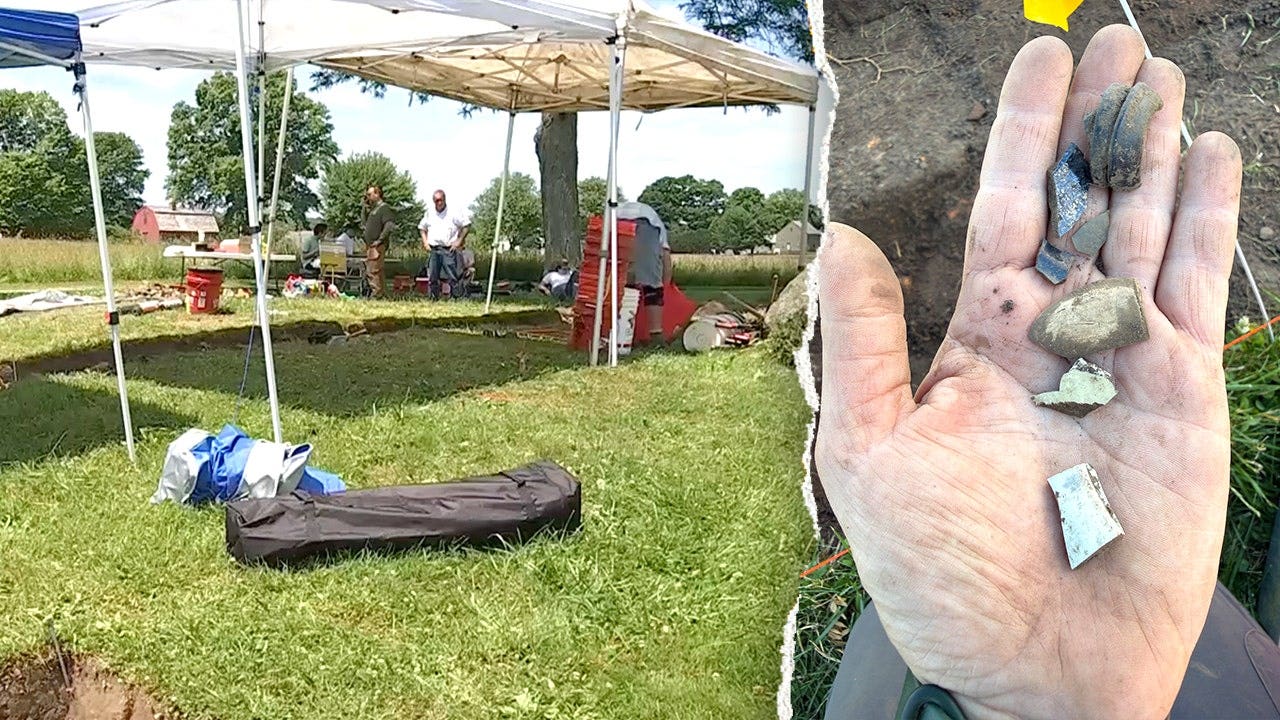
Archaeologists excavating Lebanon Town Green in Lebanon, Connecticut, uncovered the foundation and remains of an 18th-century bake house in June. The structure is believed to have been used to bake bread for French troops who camped in the area during the American Revolution as part of General Rochambeau’s expedition. Finds were limited overall, but investigators recovered artifacts including late-18th-century ceramics, clay pipe fragments, bottle glass, animal bone fragments, and a burned gunflint likely dating to the Revolutionary War era. A commemorative plaque had long marked the suspected location; an undocumented amateur dig in 1896 reportedly exposed masonry and bricks but left no preserved records. State archaeologists said the foundation appears largely intact, composed of stone with brick likely used for the oven, and that ground-penetrating radar previously indicated possible additional structures nearby. Further testing and investigation are planned for the fall as part of a broader project documenting Revolutionary War–era sites in the town related to militia training, a possible French hospital, and Rochambeau’s route during the 250th anniversary efforts.
Biblical Reflection
This report is a straightforward local archaeology story that confirms a long-held historical local tradition: a French military bake house stood on the Lebanon town green during the Revolutionary War. The article relies primarily on statements from the state archaeologist and contextualizes the find within the larger Rochambeau campaign, so its central factual claims are modest and verifiable; it does not make sweeping historical revisions. Christians reading this can appreciate several virtues: a commitment to truth in confirming oral or commemorative history with evidence, gratitude for international friendship (the French assistance), and wise stewardship in preserving cultural memory. At the same time, avoid the twin errors of sentimentalizing or sanitizing war—archaeology often illuminates ordinary human realities (hunger, care for the wounded, daily logistics) rather than heroic myth. The modest number of artifacts and the need for further testing also counsel humility: preliminary finds invite careful, patient scholarship rather than rushed conclusions. Pray for responsible preservation that honors both the facts and the human lives behind them.
Scripture in context
This outlook does not yet include contextual Scripture citations. Do not treat a general biblical theme as an exegetical conclusion.
Faithful Response
No prescribed response is offered. Consider the reflection prompts below in your own church context.
Reflection and Discussion
- 1How does confirming a local historical tradition by scientific excavation change our responsibility to remember and teach that history?
- 2Are we tempted to turn archaeological finds into simple affirmations of national pride rather than sober reminders of the human costs and complexities of war?
- 3What responsibilities do communities and churches have in preserving and interpreting historical sites for future generations?
Sources
Reporting links are evidence inputs; Sanctuary News' biblical reflection is commentary.
This outlook currently relies on fewer than two linked sources. Broaden verification before teaching from it.
- 1.Original reportprimary