News Summary
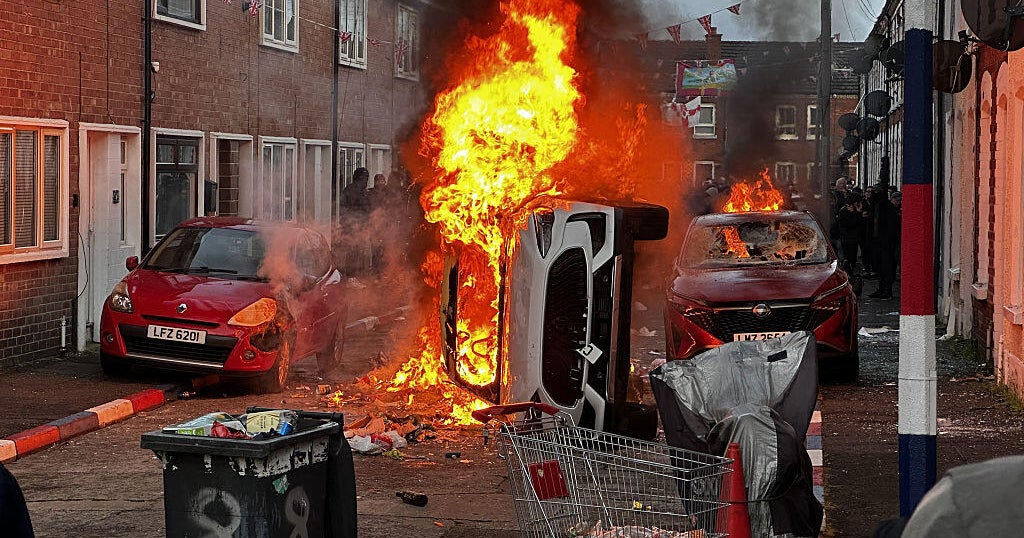
A graphic video of a violent stabbing in Belfast circulated online; police detained and charged a Sudanese man in his 30s with attempted murder, possession of a knife in a public place, and making threats to kill. The victim sustained serious injuries and was hospitalized. The accused had entered the U.K. after applying for asylum and previously held a five-year U.K. visa; he is due in court. Far-right figures and numerous social media accounts called for mass protests after the video spread. Despite calls for calm from police and politicians, dozens of masked demonstrators carried out violent anti-immigration protests across parts of Belfast, setting fire to a bus, cars, trash cans, and some homes in neighborhoods with large immigrant populations. Northern Ireland Fire & Rescue responded to 62 incidents in one evening. Political leaders from multiple parties condemned both the stabbing and the subsequent violence; police said there was no indication the stabbing was terror-related, and investigations into motive continue. Commentators and some politicians linked the unrest to online amplification, accusations of biased policing in prior cases, and broader public frustration over immigration and public services.
Biblical Reflection
This story exposes two distinct moral failures: a brutal act of interpersonal violence that requires lawful investigation and accountability, and a communal response that quickly slipped into collective punishment, arson, and vigilante intimidation of innocent families. The media account is largely factual—reporting arrests, charges, the spread of video, and the resulting attacks—while also noting claims that far-right figures amplified the footage and urged demonstrations. Christians should resist simplified narratives that make a single headline stand for an entire people-group or policy: the criminal act of one person does not justify violence toward whole communities. At the same time, legitimate public concerns about housing, services, and safety are vulnerable to exploitation when fear is stoked online and when politicians or influencers traffic in inflammatory rhetoric. Gospel-shaped responses call for truth (a careful attention to verified facts and fair process), mercy (protecting vulnerable neighbors, especially those newly arrived), and justice (holding perpetrators accountable through law, not by mobs). Pastoral care requires denouncing both the original violent assault and the racist, lawless reprisals, advocating for the protection of innocent families, and urging leaders to address underlying policy pressures without tolerating scapegoating.
Scripture in context
This outlook does not yet include contextual Scripture citations. Do not treat a general biblical theme as an exegetical conclusion.
Faithful Response
No prescribed response is offered. Consider the reflection prompts below in your own church context.
Reflection and Discussion
- 1Who is being dehumanized in the public conversation, and how does that shape who we feel justified to harm?
- 2How has rapid social media amplification changed the moral responsibility of bystanders, influencers, and leaders in moments of crisis?
- 3Are legitimate concerns about housing and public services being addressed, or are they being redirected into anger against vulnerable people?
Sources
Reporting links are evidence inputs; Sanctuary News' biblical reflection is commentary.
This outlook currently relies on fewer than two linked sources. Broaden verification before teaching from it.
- 1.Original reportprimary