News Summary
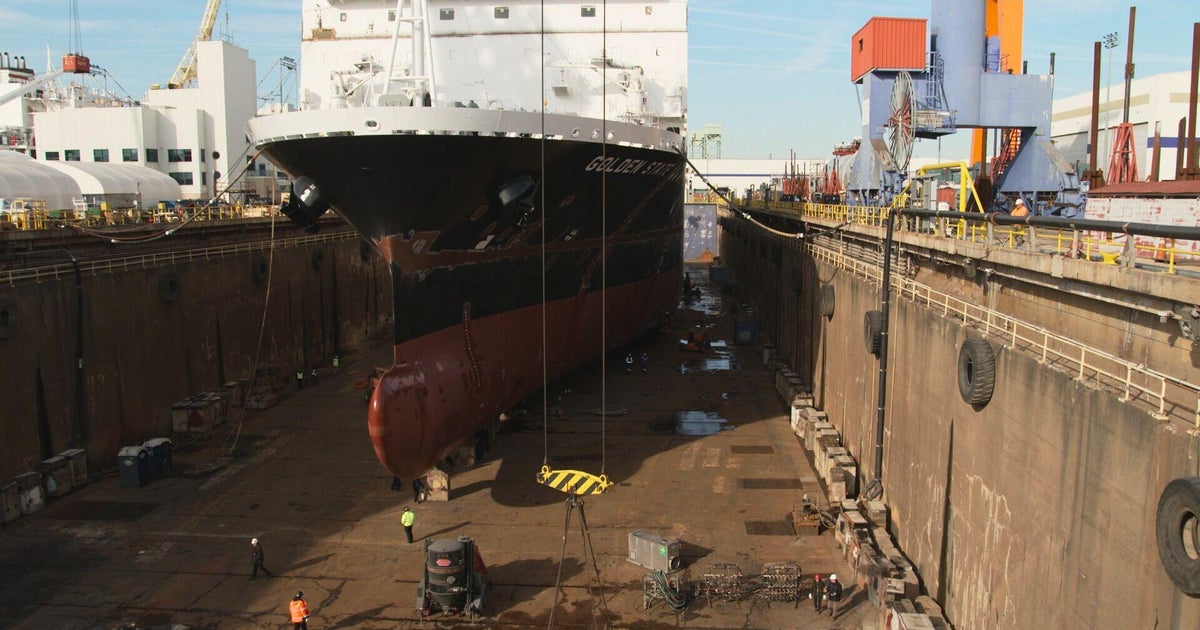
CBS News reports that U.S. commercial and military shipbuilding capacity has declined sharply: China builds roughly 1,000 cargo ships per year while the U.S. builds perhaps three. U.S. submarine construction is slow and commercial shipbuilding is nearly nonexistent. Hanwha, a South Korean company, bought the Philadelphia shipyard in 2024 and has invested to modernize it, planning further investment (reported plans up to $5 billion) and targeting higher output (aspirations up to 20 ships per year) and thousands of new jobs, though the yard currently delivers roughly one to 1.5 ships per year. The Korean yard demonstrates far greater scale, automation, and training capacity than the Philadelphia site. The article cites structural obstacles in the U.S.: high domestic steel costs exacerbated by tariffs, shortages of skilled tradespeople, long apprenticeship timelines, reliance on imported key components, and restrictive visa/immigration policies that limit foreign skilled labor. The Jones Act means domestic coastal cargo must travel on U.S.-built ships, but there are no U.S.-built LNG carriers; building one in Asia costs about $260 million while domestic construction is estimated to cost about $1 billion, rendering some internal fuel shipments uneconomical and contributing to situations where regions such as New England import overseas LNG. The Trump administration has called shipbuilding a national security crisis, created a White House shipbuilding office and multi-agency plan, temporarily suspended the Jones Act for gas shipments amid the Iran war, and faces internal policy tensions (e.g., tariffs and tighter immigration alongside efforts to revive shipbuilding). The piece also notes an ICE raid at a Korean plant in Georgia that detained hundreds of Korean technicians, which strained relations with foreign partners. South Korea reportedly offered large-scale investment (reported at $150 billion) as an alternative to threatened trade penalties.
Biblical Reflection
From a Christian perspective the story raises questions of stewardship, prudence, and humility. The underlying intention in calls to rebuild shipbuilding—protecting commerce, national security, and energy supply—is legitimate and aligns with caring for the common good. The reporting highlights contradictions in public policy (tariffs raising costs while demanding domestic production, restrictive visa practices while inviting foreign investment and expertise) that suggest political posturing can trump wise, integrated policymaking. There are real human consequences: jobs, worker safety and training, and regional energy access. Christians should guard against national pride that refuses help, and against policies that harm vulnerable workers or estrange potential partners; at the same time, prudence requires rebuilding critical capacity to protect neighbors and allies. The article’s framing emphasizes decline and crisis; while many facts seem credible, some cost and production figures are high-level estimates and rely on industry claims. The faithful response is to seek truthful analysis, press leaders for consistent, long-term solutions (investment in skills training, responsible trade and procurement strategies, and humane immigration policies where appropriate), and to pursue cooperation with foreign partners without sacrificing justice or the common welfare.
Scripture in context
This outlook does not yet include contextual Scripture citations. Do not treat a general biblical theme as an exegetical conclusion.
Faithful Response
No prescribed response is offered. Consider the reflection prompts below in your own church context.
Reflection and Discussion
- 1Are our policies coherent: do tariffs, visa limits, and industrial strategy work together or undermine the goal of rebuilding critical capacity?
- 2How does national security rhetoric interact with economic reality—are we prioritizing short-term political signals over long-term investment and workforce formation?
- 3Do we view foreign partners as threats or as neighbors who can help restore what we cannot rapidly rebuild on our own?
Sources
Reporting links are evidence inputs; Sanctuary News' biblical reflection is commentary.
This outlook currently relies on fewer than two linked sources. Broaden verification before teaching from it.
- 1.Original reportprimary