News Summary
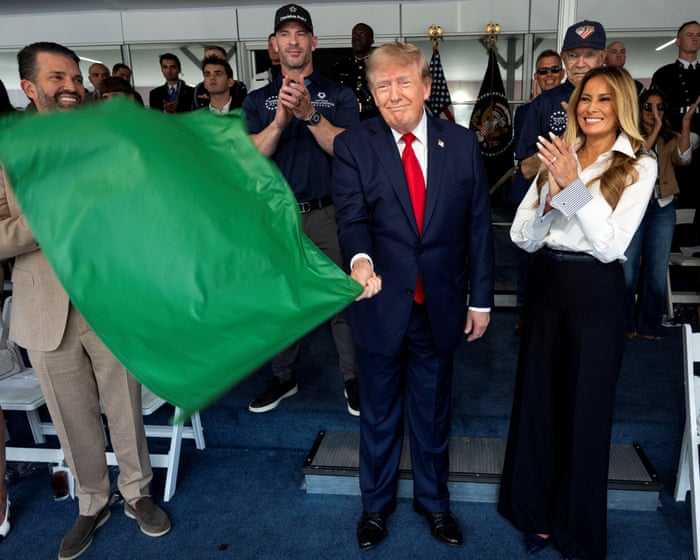
At the Freedom 250 IndyCar race in Washington, D.C., President Donald Trump waved the green flag to start the event. The Guardian reports that Trump initially misheld the flag and was helped by First Lady Melania Trump and Command Sgt Maj Matt Williams before waving it; the race was won by Kyle Kirkwood. The Guardian piece pairs those concrete scene details with strongly worded, opinionated claims about broader actions in Washington since Trump’s return (for example, alleged National Guard deployments, damage to the Lincoln Memorial reflecting pool, changes to the White House East Wing, criticism of the Kennedy Center, placement of the president’s image at the Department of Justice, and plans for a triumphal arch). Those larger claims are presented with vivid rhetorical framing in the article and are not independently documented within the piece, so they require corroboration before being treated as established fact.
Source and Framing Analysis
Primary source: The Guardian feature cited in this cluster. Strengths: the piece supplies specific, verifiable scene details useful to the cluster — the name of the event (Freedom 250), the race winner (Kyle Kirkwood), and a short descriptive episode about the president’s interaction with the green flag and who assisted him. Framing and limits: the article mixes reportage with sharp editorializing and hyperbolic language (e.g., describing the visit as a 'conquest' or asserting landmark damage and structural demolitions) without attaching attributions, documentation, or quotes to those consequential claims. Omissions include lack of official statements from the White House, Secret Service, National Park Service, race organizers, or relevant cultural institutions; no photographic or agency evidence is included for the broader allegations; and the piece provides few logistical details (security measures, permits, crowd size, timing). Readers should treat the immediate event description as reportable material from the article while treating the wider assertions as opinionated claims that need independent verification. The tone and rhetorical choices indicate a critical editorial stance, which is a legitimate genre but must be distinguished from corroborated factual reporting.
How sources covered this story
Sanctuary separately assesses reporting quality and alignment with Christian virtues. The virtues assessment considers truthfulness, dignity, compassion, justice, peacemaking, humility, and care for vulnerable people. It does not assess a publisher's faith or reward religious language.
Compare 1 reports
Reporting 68/100Virtues 45/100
- Distinctive contribution
- Names the race (Freedom 250) and the winner (Kyle Kirkwood); reports that Trump initially held the green flag incorrectly and was corrected by Melania Trump and Command Sgt Maj Matt Williams; describes the president’s enthusiastic flag-waving and frames the event as a 'rally on wheels' in Washington, DC.
- Framing
- Opinionated and critical. Uses pejorative, hyperbolic language (e.g., 'conquest of Washington', 'wrecked the Lincoln Memorial reflecting pool', 'demolished the East Wing') and satirical imagery to portray the visit as spectacle and political takeover rather than a neutral sporting appearance. Mixes scene-setting reportage with editorializing.
- Omissions or uncertainty
- No date or time beyond URL date; no attributions or sourcing for larger claims (e.g., 'deployed the national guard', damage to landmarks) — unclear whether literal or figurative; no quotes from event organizers, attendees, security, or officials; lacks logistical details (security measures, permits, crowd size) and context (purpose/official justification for the event).
- Why these scores
- The excerpt offers specific, verifiable facts useful to readers (race name, winner, the flag incident and who intervened) and vivid scene description. However, it blends factual reporting with strongly opinionated and hyperbolic claims without attribution or evidence, reducing its reliability as straight news. For a short color/feature piece this is acceptable, but the editorializing should be treated as opinion rather than confirmed factual reporting. The excerpt is largely critical and mocking in tone, employing demeaning and hyperbolic language that undermines dignity and humility in reporting. It does not demonstrate compassion or constructive engagement and lacks balanced attribution for some serious-seeming claims. It does not, however, promote violence or explicit dehumanization, which prevents a lower score.
Biblical Reflection
A Christian response to 'Trump Waves Green Flag at Freedom 250 Race' should separate two tasks: careful assessment of facts and formation of moral-spiritual judgment. Truth demands that we verify consequential claims before acting or accusing; mercy and care demand attention to any real harms to people or public property. Christians should refuse spectacle as the sole metric of leadership and instead evaluate actions by whether they serve the vulnerable, uphold justice, and repair the common good. When political theater crowds public life, the church’s vocation is to call leaders and neighbors toward humility, truthful accountability, and practical service—offering help where civic goods are damaged, advocating for transparent information, and resisting partisan caricature in our own speech. This outlook prioritizes dignity, peacemaking, and faithful civic engagement over rhetorical victory.
Scripture in context
- 1Philippians 2:3-11 — Paul exhorts believers to humility, asking them to consider others better than themselves and pointing to Christ’s self-emptying as the model for leadership and community life. — This passage invites Christians to judge political spectacle against the standard of servant leadership: evaluate actions by whether they honor others, protect the vulnerable, and seek the common good rather than personal aggrandizement.
Faithful Response
Treat the immediate reporting elements (flag-waving episode, race winner) as items reported by The Guardian, and seek independent confirmation for consequential claims before amplifying them.
Request or seek official statements and documentary evidence (photographs, agency reports, park service or White House communications, race-organizer statements) for claims about National Guard deployments, property damage, or structural changes.
If verified damage or harms exist, mobilize practical local care (volunteer cleanup, financial or logistical support to municipal workers, partnership with civic agencies) and pastoral support for those affected.
Organize a factual briefing or Q&A with knowledgeable local officials or journalists to separate verified facts from opinion for congregation and community groups.
Model civil speech: critique policies and public actions with truthful, charitable language; avoid trading in unverified rumors or dehumanizing rhetoric.
Pray for leaders and for neighbors affected by policy or property changes, asking for wisdom, humility, and repair of communal harms.
Reflection and Discussion
- 1How should the church distinguish between spectacle and substantive governance when political events are presented as theatrical displays?
- 2When a news piece blends vivid opinion with factual reporting, what disciplines (verification, restraint, charity) should Christians practice before forming public judgments?
- 3What concrete responsibilities do Christians and congregations have to repair or care for public spaces and civic institutions if the article’s claims about damage or deployments are confirmed?
Sources
Reporting links are evidence inputs; Sanctuary News' biblical reflection is commentary.
This outlook currently relies on fewer than two linked sources. Broaden verification before teaching from it.
- 1.Donald’s big day out at Washington’s IndyCar race – from furious flag-waving to dubious weather forecastingprimary_reporting