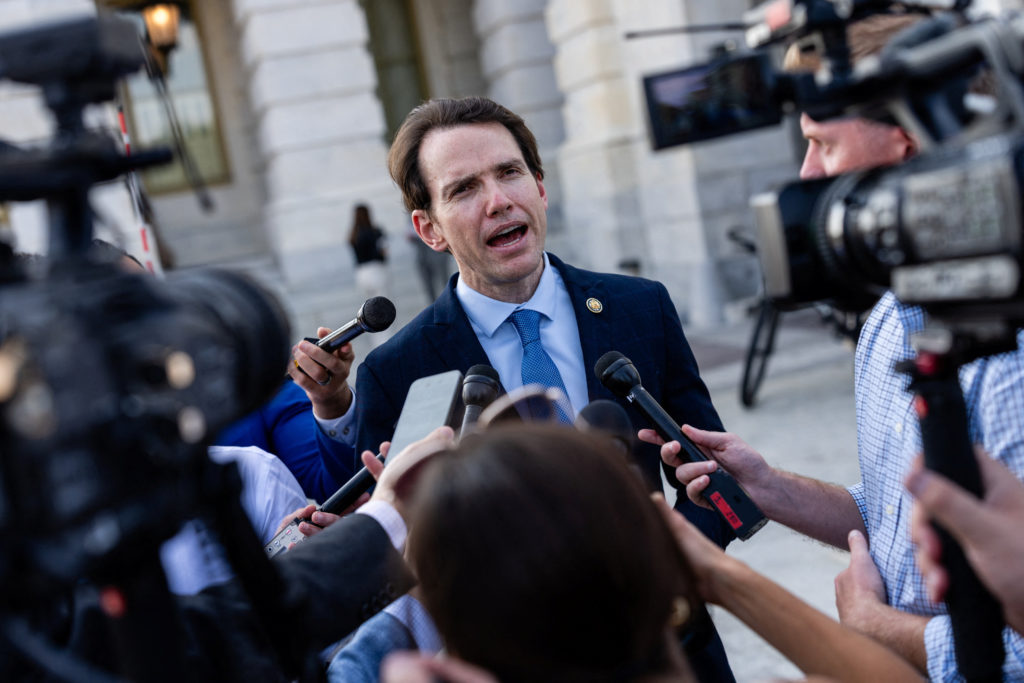
News Summary
The supplied PBS NewsHour excerpt reports that President Donald Trump told Republican-controlled states to redraw congressional district maps before the midterm elections with the stated purpose of increasing the number of winnable seats for Republicans to help the party retain control of the U.S. House. The article headline asserts a broader outcome — that Republicans 'won the redistricting competition' — and implies disagreement from an unnamed California congressman, but the excerpted body sentence supplies no named quotes, data, timeline, or the congressman's identity or statements. The claim that Trump urged map changes is plainly presented; the alleged outcome and the congressman's dispute are asserted by the headline without supporting material in the supplied text.
Source and Framing Analysis
Source: PBS NewsHour (single supplied excerpt). Source-specific details: the excerpt explicitly attributes an instruction to President Trump directing GOP-controlled states to redraw maps before the midterms to increase Republican-winnable seats. Framing: the published headline frames the situation as a clear partisan 'win' for Republicans in redistricting and adds an angle of dispute by referencing a California congressman who allegedly disagrees. Disagreements and uncertainties: within the single supplied piece there is a tension between the declarative headline ('Republicans won the redistricting competition') and the article body excerpt, which only reports the instruction without offering evidence of the claimed outcome, identifying the congressman, providing quotes, or giving analysis of seat changes. Absent from the excerpt are: specific states affected, dates or venues of the reported instruction, documentary or quoted sources, map analyses, seat-change statistics, and independent corroboration. Those omissions make the strength of the headline's outcome claim unclear and invite caution in interpretation.
How sources covered this story
Sanctuary separately assesses reporting quality and alignment with Christian virtues. The virtues assessment considers truthfulness, dignity, compassion, justice, peacemaking, humility, and care for vulnerable people. It does not assess a publisher's faith or reward religious language.
Compare 1 reports
Reporting 65/100Virtues 70/100
- Distinctive contribution
- Asserts that Trump explicitly told GOP-controlled states to redraw maps before the midterm elections to increase winnable Republican seats, linking presidential direction to state redistricting timing and partisan advantage.
- Framing
- Frames redistricting as an intentional, strategic partisan maneuver ordered by the president to help Republicans retain power; concise and declarative with a political/strategic emphasis.
- Omissions or uncertainty
- No sourcing or attribution provided in the excerpt (who reported Trump's instruction, where/when he said it). Lacks specifics: which states, what maps, how many seats, whether the instruction had measurable effects. The sentence appears truncated at the end, leaving uncertainty about the full claim.
- Why these scores
- The excerpt conveys a clear, potentially verifiable claim and supplies timely context, but it lacks attribution, supporting evidence, and specificity. The truncation reduces clarity. As a brief contextual statement it is adequate, but not fully substantiated within the supplied text. The language is neutral and non-dehumanizing, presenting a factual/political claim without inflammatory rhetoric or exploitation of suffering. It neither emphasizes compassion nor justice explicitly, so it aligns moderately with virtues like truthfulness and respect for persons but offers limited moral or empathetic context.
Biblical Reflection
Christian concern here centers on how political power and institutional design affect neighbors—especially those already marginalized. Questions of stewardship, justice, and the common good are central: are public processes being used to secure fair representation or to entrench partisan advantage? Our response should center truth (careful discernment of facts), mercy (concern for those whose voices may be diminished), justice (advocating equitable representation), peacemaking (avoiding dehumanizing rhetoric), humility (resisting partisan triumphalism), and care for vulnerable neighbors (attending to communities likely to lose influence). This ethical stance is distinct from reporting facts: it shapes how Christians interpret and act on information about redistricting without substituting moral judgments for evidentiary claims.
Scripture in context
- 1Micah 6:8 — A prophetic demand for doing justice, seeking mercy, and walking humbly before God amid social and political failure. — Use this ethic to ask whether political practices—such as redrawing maps for partisan gain—advance justice and mercy for neighbors or instead concentrate power and weaken accountability.
- 2Proverbs 31:8-9 — An instruction to speak up for those who cannot speak and defend the rights of the poor and needy. — Reminds Christians to advocate for processes that protect the representation and political voice of vulnerable communities affected by redistricting.
- 3Luke 10:25-37 (the parable of the Good Samaritan) — A call to active neighbor-love that crosses lines of identity and self-interest to help those in need. — Encourages concern for real people whose resources and political influence can be altered by institutional decisions about voting maps, prompting concrete care and civic engagement.
Faithful Response
Clarify facts before acting: seek the original reporting, public statements, hearing records, redistricting maps, and independent analyses that can confirm when and where the instruction was given and its measurable effects on seats.
Advocate for fair processes: support transparency, public hearings, independent or nonpartisan redistricting commissions, and clear standards that prioritize equal representation and protection of minority voting rights.
Support affected communities: partner with local civic organizations to provide voter education, registration assistance, and legal resources for communities that may lose representation.
Model Christian civic posture: practice truth-telling, resist partisan demonization, pursue restorative engagement across political lines, and provide pastoral care to those feeling disenfranchised.
Reflection and Discussion
- 1Who stands to benefit and who stands to lose if maps are redrawn for partisan advantage, and how does that square with our calling to love and protect neighbors?
- 2Does describing institutional outcomes as a 'win' obscure moral obligations tied to fair representation and accountability?
- 3How can our congregation exercise civic responsibility—through advocacy, voting, and accompaniment—without surrendering Christian commitments to humility and peacemaking?
- 4What specific information would we need to move from concern to effective action or advocacy in our local context?
Sources
Reporting links are evidence inputs; Sanctuary News' biblical reflection is commentary.
This outlook currently relies on fewer than two linked sources. Broaden verification before teaching from it.
- 1.Republicans won the redistricting competition. Don't tell that to this California congressmanprimary_reporting