News Summary
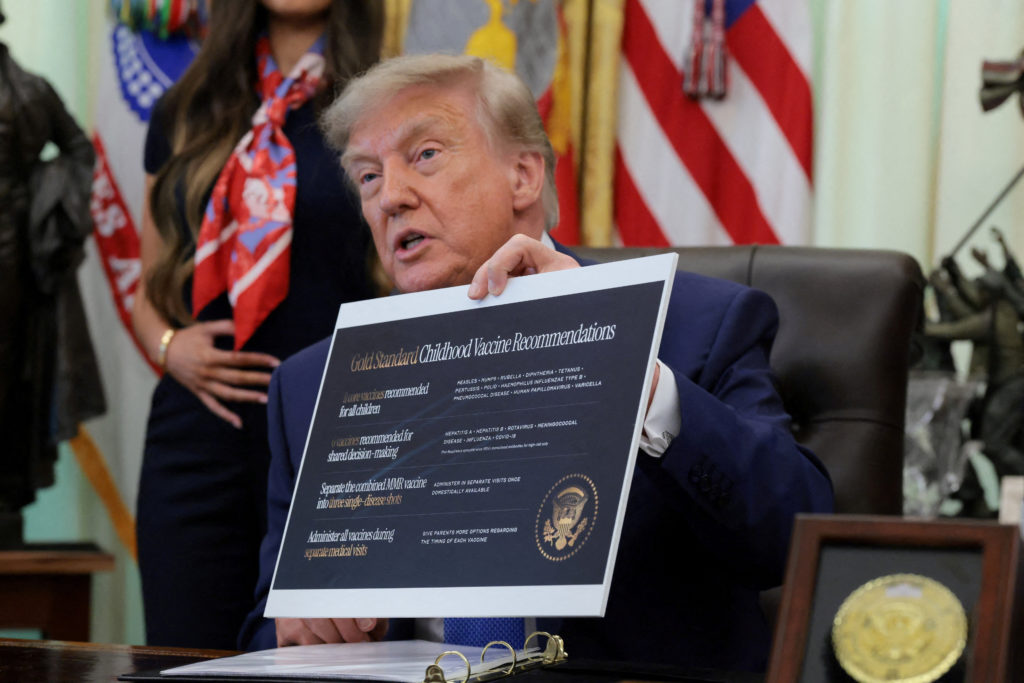
Multiple outlets (PBS NewsHour, CBS News, The Guardian) report that President Trump signed an executive order addressing the federal approach to childhood vaccination schedules. Supplied reporting and a White House fact sheet (as cited by PBS and PBS video/watch excerpts) attribute to the order a recommendation to split the MMR (measles, mumps, rubella) series into separate visits and a directive to the health department to "improve vaccine research." Some live/update excerpts in the supplied material state the administration would "no longer recommend" hepatitis B, COVID‑19, and influenza shots for children. The supplied coverage does not include the full text of the order, an official full White House release, CDC or state health‑department statements, named independent public‑health expert commentary, or legal analysis; key implementation and legal details therefore remain unverified.
How sources covered this story
Sanctuary separately assesses reporting quality and alignment with Christian virtues. The virtues assessment considers truthfulness, dignity, compassion, justice, peacemaking, humility, and care for vulnerable people. It does not assess a publisher's faith or reward religious language.
Compare 8 reports
Reporting 80/100Virtues 75/100
- Distinctive contribution
- Identifies that HHS published a Federal Register notice soliciting public comment on the existing recommendation categories (routine, risk-based, shared clinical decision-making) and conveys experts’ immediate concerns about confusion and access.
- Framing
- Frames the action as a public consultation while foregrounding expert warnings that it will sow confusion and create access challenges.
- Omissions or uncertainty
- Does not name the HHS official(s) responsible, does not quote or identify the experts, lacks date/time specifics of the notice beyond “on Friday,” and does not present HHS’s stated rationale or expected legal effect.
- Why these scores
- Clear, specific about the Federal Register notice and the categories under review and attributes concern to experts; score reflects solid sourcing and relevance but deducts for absence of named expert sources, HHS perspective, and limited procedural detail in the excerpt. The excerpt responsibly highlights potential harms (confusion, access challenges) and centers expert concern, reflecting care for public well-being and truthfulness; score reduced modestly because the supplied text lacks named sources or direct evidence of mitigation efforts.
Reporting 74/100Virtues 73/100
- Distinctive contribution
- Reports specific measures from the White House fact sheet: recommending splitting MMR into separate visits and directing HHS to enhance vaccine research, providing direct detail on the order’s stated directives.
- Framing
- Neutral reporting that attributes the provisions to a White House fact sheet, which clarifies source of the claims.
- Omissions or uncertainty
- Does not assess whether these recommendations are legally binding, lacks expert reaction or implementation details, and the excerpt does not quote the fact sheet directly.
- Why these scores
- Good attribution (White House fact sheet) and useful specificity about the order’s stated provisions; score reduced because the excerpt lacks expert assessment, legal analysis, and direct quotations. Attribution to an official document and factual tone support truthfulness and transparency; raising substantive policy changes by citation aids informed public discussion and care for public welfare.
Reporting 76/100Virtues 72/100
- Distinctive contribution
- Names Dr. Heidi Overton as Trump’s pick for FDA and states she has supported overhauling the childhood vaccine schedule — connecting personnel to policy direction and noting criticism from medical experts.
- Framing
- Presents the nomination factually while noting that Overton is a strong supporter of the president’s agenda and that her positions have drawn sharp criticism from medical experts.
- Omissions or uncertainty
- Excerpt lacks specific examples of Overton’s statements or actions, details of the criticisms, and documentary evidence of her policy proposals or qualifications.
- Why these scores
- Concise, informative and appropriately attributes controversy to medical experts; score lowered because the excerpt doesn’t include named critics, direct quotes, or evidence supporting the asserted policy positions. The excerpt is measured and non‑sensational, attributing disagreement to experts and providing context about potential impacts on public health; it shows respect for truth and public welfare though it lacks deeper human-centered context.
Reporting 78/100Virtues 70/100
- Distinctive contribution
- Clarifies that the executive order does not in itself change US vaccine recommendations, describes likely public-health consequences (undermining trust, possible illness/deaths), and links the order to earlier RFK Jr. actions that were judicially halted.
- Framing
- Frames the order as symbolically impactful but legally impotent with potentially harmful public-health consequences, grounded in expert warnings and legal history.
- Omissions or uncertainty
- Does not provide the judge’s rationale or case details, lacks named experts or statistical estimates of anticipated harms, and does not include the administration’s stated purpose for the order in the excerpt.
- Why these scores
- Provides important legal and public-health context and links to prior administrative actions; well-focused for its purpose, but the excerpt omits named sources and detailed evidence for the asserted health impacts. Highlights potential harms and the public-interest implications of the policy, reflecting concern for vulnerable populations; score tempered because the excerpt emphasizes risk without presenting administrative justification or mitigation steps.
Reporting 68/100Virtues 70/100
- Distinctive contribution
- Concise confirmation that an executive order was signed directing fewer vaccines and more spacing between visits, situating the event among other national items.
- Framing
- Brief, headline-style summary; neutral in tone within a broader news roundup.
- Omissions or uncertainty
- No detail on the order’s legal authority, text, expert reaction, or implementation mechanics; the excerpt is inherently cursory.
- Why these scores
- Appropriate for a news wrap — accurate and concise — but limited depth and sourcing in the supplied text make it adequate rather than robust. Neutral, factual presentation without sensational language; does not dehumanize or exploit suffering, showing basic respect for truthfulness and public information.
Rank 6
The Guardian: Trump signs order attempting to override CDC vaccine schedule and break up MMR shotsReporting 66/100Virtues 69/100
- Distinctive contribution
- Reiterates the fact of the executive order signing and its intent to alter the CDC schedule (as described in the headline/excerpt).
- Framing
- Brief, factual statement; the headline context implies a contentious attempt to override CDC guidance but the supplied line is neutral.
- Omissions or uncertainty
- No detail about the order’s text, legal mechanisms, expert responses, or timeline; excerpt is a single-sentence report.
- Why these scores
- Accurate and terse; the excerpt fulfills a basic news function but lacks sourcing, context, and detail required for higher assessment. Neutral factual reporting that avoids sensationalism and respects truthfulness; minimal detail limits stronger assessment of concern for vulnerable populations.
Reporting 72/100Virtues 68/100
- Distinctive contribution
- Specifies vaccines the administration said it would no longer recommend for children (hepatitis B, Covid-19, influenza), adding concrete scope to reports of the order.
- Framing
- Presented as part of live coverage; the detail appears as a reported statement of administration intent, implying significant change but without legal analysis in the excerpt.
- Omissions or uncertainty
- No direct quotation or sourcing for the administration’s claim in the excerpt, no discussion of legal effect or public-health implications, and no named officials or documents cited.
- Why these scores
- Provides an important, specific claim that is highly relevant; scored as solid reporting for specificity, but the supplied excerpt lacks attribution, direct sourcing, and legal context. The excerpt raises public-health implications by naming vaccines potentially de-emphasized — reflecting concern for public welfare — but its lack of source attribution reduces transparency and thus slightly lowers the alignment score.
Reporting 66/100Virtues 68/100
- Distinctive contribution
- Simple factual confirmation of the signing of an executive order on childhood vaccine schedules.
- Framing
- Plain, factual; no evaluative language in the supplied excerpt.
- Omissions or uncertainty
- No information about the content of the order, its legal effect, reactions, or source documentation in the excerpt.
- Why these scores
- Accurate but minimal; the excerpt achieves a basic factual purpose but provides no sourcing, context, or detail to assess implications. Neutral and factual; aligns with virtues of truthfulness and clarity but the brevity offers little demonstration of care for affected groups.
Biblical Reflection
Our Christian public witness calls us to pursue truth and the common good while acting with mercy, justice, peacemaking, humility, and care for vulnerable neighbors. When government announcements touch children’s health, seek primary documents and trusted expert guidance before forming policy judgments or pastoral direction. Prioritize protection for those who cannot speak for themselves (young children, medically vulnerable people). Resist partisan simplification and rumor, and practice patience with uncertainty. Pastors and congregations should pair calm pastoral care with careful verification: help families access trustworthy medical advice, advocate for policies that protect the weak, and cultivate speech marked by humility, love, and respect for human dignity.
Scripture in context
- 1Romans 13:1–7 — Paul addresses Christians’ relationship to governing authorities and the social order that affects public life and welfare. — This passage invites responsible civic participation and lawfulness while reminding Christians that allegiance to God should shape how we evaluate civil policies — including asking whether policies serve the common good and protect the vulnerable.
- 2Matthew 22:37–39 (Great Commandment) — Jesus centers moral life around loving God and loving neighbor. — When public‑health news provokes fear or division, filter responses through neighbor‑love: prioritize measures that protect children and the medically fragile, and practice mercy and humility in public discourse.
Faithful Response
Treat the supplied reports as initial reporting that require primary‑source verification before changing congregational practice or pastoral guidance.
Obtain the full text of the reported executive order or an official White House release to determine precise directives, scope, and which agencies or statutory authorities (if any) are directed.
Consult trusted public‑health authorities before offering medical or policy advice to members: CDC, state health departments, the American Academy of Pediatrics, and local pediatricians or public‑health clinicians.
Host a congregational Q&A with local healthcare professionals to address parents’ questions and to disseminate vetted medical information.
Discourage congregation members from amplifying terse summaries or live snippets as complete factual accounts; model careful citation and restraint while clarifying what is and is not yet verified.
Provide practical pastoral care: help families arrange access to clinics (transportation, scheduling), offer counseling or prayer for those anxious about the news, and make clear support available for medically vulnerable members.
Monitor official statements from the White House, CDC, state health departments, and professional medical societies for clarifications and guidance on implementation, safety, and legal effect.
Reflection and Discussion
- 1What concrete steps can our congregation take now to help parents and medically vulnerable members access reliable health guidance?
- 2How do we balance respect for civil authority with the responsibility to verify facts and protect neighbors when government announcements affect public health?
- 3How will we model humility and mercy in speech and social media when news is incomplete or polarized?
- 4What pastoral resources and local professional relationships (clinicians, public‑health officials) should we cultivate so we can respond responsibly to future health‑policy news?
Sources
Reporting links are evidence inputs; Sanctuary News' biblical reflection is commentary.
This outlook currently relies on fewer than two linked sources. Broaden verification before teaching from it.
- 1.News Wrap: Trump signs order calling for MMR vaccine split into 3 shotsprimary_reporting