News Summary
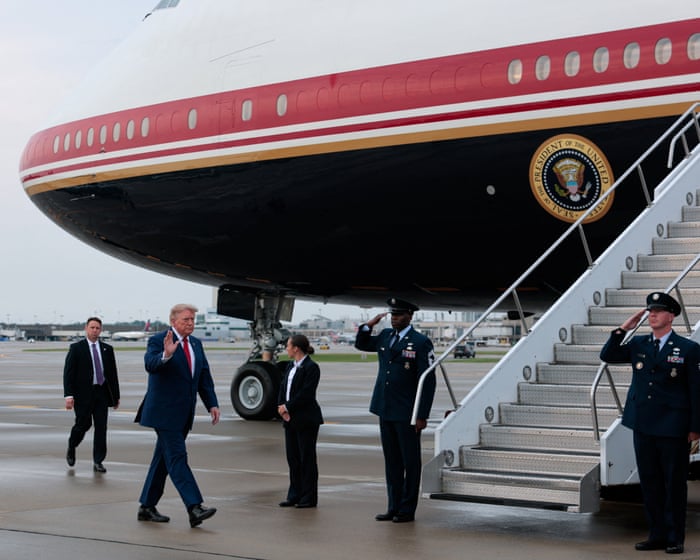
A Guardian live blog reports that President Trump said he left Air Force One after a trip to Turkey because the Secret Service and military wanted him on a “different plane” in response to a reported threat; Trump said the threat did not frighten him. The report also says critics raised questions about alleged use of “decoy” passengers and that Democrats have requested a congressional briefing. The live update attributes the account to the president and records political reaction but does not supply independent confirmation from the Secret Service, the Pentagon, or passenger/security records.
Source and Framing Analysis
Source: The Guardian live blog is a rolling-report item that attributes the plane-switch account directly to President Trump and summarizes immediate political reactions. Strengths: it clearly attributes claims to the president, notes political fallout, and signals uncertainty by not asserting unverified details as fact. Limitations and framing effects: as live coverage, it lacks primary-source confirmation (no Secret Service or Pentagon statement, no passenger manifests, no security timelines) and therefore leaves key operational details unresolved. The framing emphasizes controversy (mentions of alleged “decoy” passengers and calls for briefings), which can amplify partisan interpretations absent corroborating material. Readers should treat the reported claims as the president’s account and as the subject of partisan dispute rather than as independently established facts.
How sources covered this story
Sanctuary separately assesses reporting quality and alignment with Christian virtues. The virtues assessment considers truthfulness, dignity, compassion, justice, peacemaking, humility, and care for vulnerable people. It does not assess a publisher's faith or reward religious language.
Compare 1 reports
Reporting 74/100Virtues 80/100
- Distinctive contribution
- Reports Trump’s account that the Secret Service and military directed him to a different plane due to a threat, and records immediate Democratic calls for a congressional briefing.
- Framing
- Presented as a live-news update/headline indicating Trump is ‘playing down’ the plane switch while criticism grows over alleged use of 'decoy' passengers; the supplied lines attribute the explanation to the president and mention political pushback.
- Omissions or uncertainty
- No details about the alleged threat (nature, source, timing), no independent confirmation from the Secret Service or military, no specifics about the alleged 'decoy' passengers, no timeline or location beyond 'after a trip last month in Turkey', and no quoted sources beyond 'President said'.
- Why these scores
- As a short live-blog update, the excerpt responsibly attributes the claim to the president and flags political response. It is concise and not misleading, but it lacks independent sourcing, specifics about the alleged threat, and corroborating detail — reasonable for a live update but limiting for definitive reporting. The snippet is neutrally worded, attributes statements rather than asserting unverified facts, and does not dehumanize or exploit subjects. It responsibly signals uncertainty by attributing the claim to the president, though stronger sourcing and context would better serve truthfulness and care for the public.
Biblical Reflection
Christians should hold two goods together: the duty to protect life (including those who serve in public office and the public they serve) and the duty to pursue truth and accountability. Protecting people legitimately requires confidentiality in some security matters, but democratic legitimacy depends on truthful explanations and lawful oversight where disclosure will not endanger lives. The faithful Christian response is to pray for those responsible for security, press for responsible oversight that respects genuine security claims, avoid rumor-mongering, and demand clear, verifiable answers when secrecy is used in ways that affect public trust. This means supporting investigators and oversight mechanisms that can review classified and unclassified material as appropriate and urging public summaries where security allows, while resisting partisan exploitation of incomplete information.
Scripture in context
- 1Proverbs (general reference) — Wisdom literature emphasizes integrity and the societal benefits of honest speech and upright leadership. — Leaders and institutions build public trust by practicing transparency and truthfulness when possible; Christians should encourage integrity and call for accountability in ways that protect the vulnerable.
- 2Micah and related prophetic themes (general reference) — Prophetic and ethical commands in Scripture call communities to pursue justice and care for neighbors, balancing protection with honest dealings. — Seeking justice includes pursuing factual clarity about public-security decisions while showing mercy and avoiding reckless accusations that harm people or institutions unjustly.
- 3Sermon-on-the-Mount themes (general reference) — Jesus' teaching on peace-making and humility highlights the need for restraint, reconciliation, and careful speech in times of conflict. — Christians should be peacemakers in public discourse—asking hard questions with humility, refusing to inflame, and working toward truth that restores communal trust.
Faithful Response
Pray for protection, wisdom, and clear judgment for security personnel, investigators, political leaders, and the public.
Treat the reported account as the president’s claim; do not present unverified operational details as established fact.
Encourage and support lawful, nonpartisan oversight: call on appropriate congressional committees or inspectors general to review relevant materials and provide public summaries where security permits.
Avoid sharing or amplifying unconfirmed allegations (for example, about ‘decoy’ passengers) and correct misinformation when encountered.
Offer pastoral care for congregants anxious about safety or distrustful of institutions; teach discernment about news sources and the limits of live reporting.
Reflection and Discussion
- 1What standards of evidence should we require before repeating or acting on security-related allegations about public officials?
- 2How can Christians balance legitimate concerns for transparency with the real need to preserve operational security in life-and-death contexts?
- 3When information is incomplete, how should humility and charity shape our public speech and private conversations?
- 4What concrete civic steps can Christians take to support both national safety and the integrity of democratic oversight?
Sources
Reporting links are evidence inputs; Sanctuary News' biblical reflection is commentary.
This outlook currently relies on fewer than two linked sources. Broaden verification before teaching from it.
- 1.Trump plays down Air Force One plane switch as criticism grows over ‘decoy’ passengers – US politics liveprimary_reporting