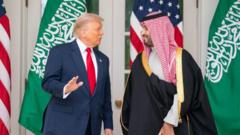
News Summary
Reported facts: The BBC headline reports a Trump-era nuclear agreement with Saudi Arabia and states that the agreement 'jettisons longstanding US demands.' Attributed claim: The article text asserts that past U.S. presidents had required Saudi Arabia to normalise relations with Israel as a condition for nuclear technology. Uncertainty: The supplied article text does not provide supporting documents, direct quotes from officials, or details of the agreement, so the core assertions cannot be independently corroborated from the provided material.
Source and Framing Analysis
Material uncertainty materially affects the story: the supplied article content is one short sentence asserting a prior U.S. policy and an implied change by the current deal, but offers no sourcing, named officials, treaty language, or timeline. The headline is assertive; the minimal article body amplifies the claim without the underlying evidence that would allow readers to evaluate its accuracy or scope. Readers should treat this as a report of an assertion rather than a fully documented factual account until corroborating sources or primary documents are provided.
Biblical Reflection
The headline raises consequential questions about nuclear non-proliferation, alliance trust, and regional stability. If prior U.S. policy tied nuclear assistance to normalization with Israel, changing that condition would alter bargaining leverage in the Middle East and could affect U.S. credibility with partners. Christians should care about truthfulness in reporting, the protection of vulnerable populations (who bear the human cost of conflict), and the stewardship of powerful technologies.
From a pastoral perspective, the story calls for measured discernment rather than partisan certainty. We should insist on verified facts before forming settled judgments, pray for those in positions of power to seek justice and peace, and advocate for transparency where policies affect lives and stability. The moral priorities in such diplomacy include truth (accurate information and honest negotiation), mercy (care for civilians and victims of violence), humility (recognizing limits of power), and peacemaking (efforts that reduce the chance of arms racing or conflict).
Scripture in context
- 1Matthew 5:9 — Part of the Sermon on the Mount where Jesus commends peacemakers and describes the character of life in God's kingdom. — This passage stresses the Christian calling to pursue peace; in international affairs that calls believers to favor diplomacy that reduces violence, protects civilians, and seeks reconciliation rather than escalating arms races.
- 2Romans 13:1-7 — Paul's instruction about the role of governing authorities in maintaining order and the believer's relation to civil institutions. — The text invites respect for legitimate authority and accountability; Christians should therefore demand lawful, transparent governance and responsible policies from leaders—especially on matters (like nuclear technology) with grave public consequences.
Faithful Response
Pray specifically for wisdom for policymakers, protection for civilians in the region, and for truthful, transparent reporting.
Seek reliable, primary-source information (official texts, statements, or multiple independent reports) before forming public judgments.
Engage the issue through informed civic channels—write elected representatives, ask questions about oversight and safeguards, and support nonproliferation and humanitarian organizations.
Reflection and Discussion
- 1How should the biblical call to pursue peace and protect the vulnerable shape our evaluation of foreign policy decisions about nuclear technology?
- 2What standards of evidence and accountability should Christians insist on before endorsing or condemning major diplomatic agreements?
- 3In what ways can the church be a voice for restraint, transparency, and the common good when state power is at stake?
Sources
Reporting links are evidence inputs; Sanctuary News' biblical reflection is commentary.
This outlook currently relies on fewer than two linked sources. Broaden verification before teaching from it.
- 1.Trump's nuclear deal with Saudis jettisons longstanding US demandsprimary_reporting