News Summary
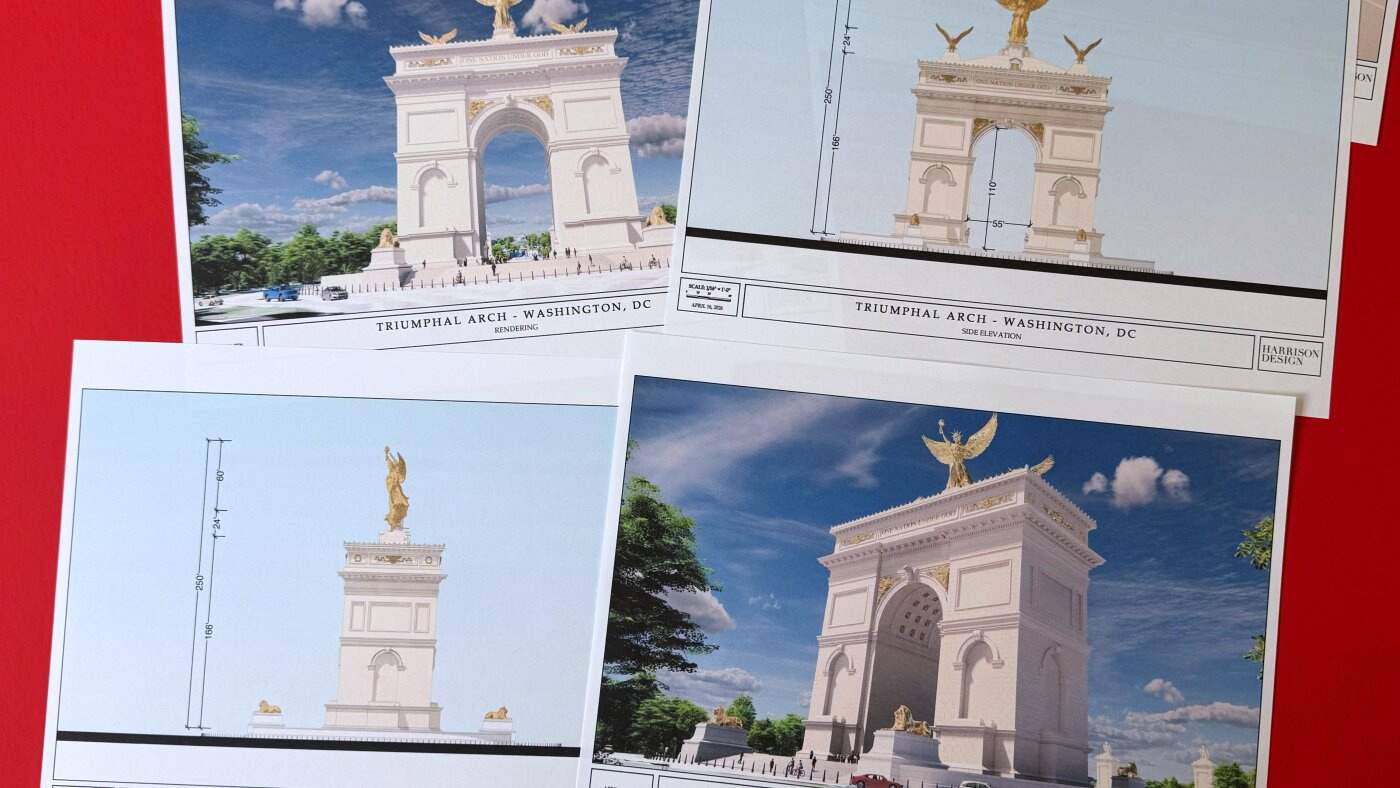
On April 10, 2026, the U.S. Commission of Fine Arts released official renderings and diagrams for a proposed 250-foot triumphal arch for the National Mall, produced by Harrison Design. The structure is planned to sit at one end of the Arlington Memorial Bridge near Arlington National Cemetery. The mockup resembles the Arc de Triomphe (but taller), features two golden eagles and a winged, crowned figure, and includes inscriptions reading "One nation under God" on one side and "Liberty and justice for all" on the other. The White House described the height as marking America's 250th birthday and said the monument would honor veterans and American sacrifice. President Trump previously displayed a model and, when asked who the monument would honor, said "Me" in a recorded exchange. A group of Vietnam War veterans filed a lawsuit in February arguing the project violates statutes requiring explicit congressional authorization for commemorative works or structures on federal park grounds. The White House says it will follow legal requirements; the National Park Service requested review by the Commission on Fine Arts, which is scheduled to review designs next week. That commission is currently composed of members appointed by President Trump following his removal of six prior members in October 2025. The estimated cost is not yet public and is expected to involve a mix of public and private funding. The arch is part of a broader set of recent architectural initiatives from the administration (including a proposed neoclassical White House ballroom, changes at the Rose Garden, and proposed renovations affecting the Kennedy Center and Dulles Airport) and follows an executive order favoring classical/traditional styles for federal buildings over $50 million.
Biblical Reflection
This story raises questions about public stewardship, the proper role of monuments, and how power is exercised in civic spaces. Monuments shape public memory; when a leader champions an enormous, highly visible structure and has personal or political ties to the decision-making apparatus, reasonable concerns about motive, process, and respect for law emerge. The article reports both government claims that the arch will honor veterans and civic sacrifice and a legal challenge by veterans arguing statutory requirements have been bypassed. From a biblical perspective, Christians should prize humility over self-exaltation (Philippians 2), honor genuine sacrifice (1 Peter 2:17), and respect lawful processes (Romans 13:1). The public square requires transparent procedures, due legislative authorization, and honest representation of intent. Monumental architecture is not inherently sinful, and honoring veterans can be a worthy aim; but when the presentation elevates a political leader, sidelines legal norms, or appears to conflate personal aggrandizement with public commemoration, the impulse runs counter to biblical warnings about pride and the misuse of authority. Evaluate claims about whom the monument honors and whether legal and ethical safeguards are being observed. Christians should advocate for truth, stewardship of public resources, and humility in public life while recognizing legitimate aims to honor sacrifice and national memory.
Scripture in context
This outlook does not yet include contextual Scripture citations. Do not treat a general biblical theme as an exegetical conclusion.
Faithful Response
No prescribed response is offered. Consider the reflection prompts below in your own church context.
Reflection and Discussion
- 1Who benefits from the narrative that a colossal monument will "give a nation its glory," and does the reported process reflect transparent stewardship of public space and funds?
- 2Are legal and institutional safeguards being respected so that commemorative projects genuinely serve the public memory rather than personal or partisan aggrandizement?
- 3How should Christians weigh the legitimate goal of honoring veterans and national sacrifice against concerns about pride, centralized control of public symbolism, and possible circumvention of law?
Sources
Reporting links are evidence inputs; Sanctuary News' biblical reflection is commentary.
This outlook currently relies on fewer than two linked sources. Broaden verification before teaching from it.
- 1.Original reportprimary