News Summary
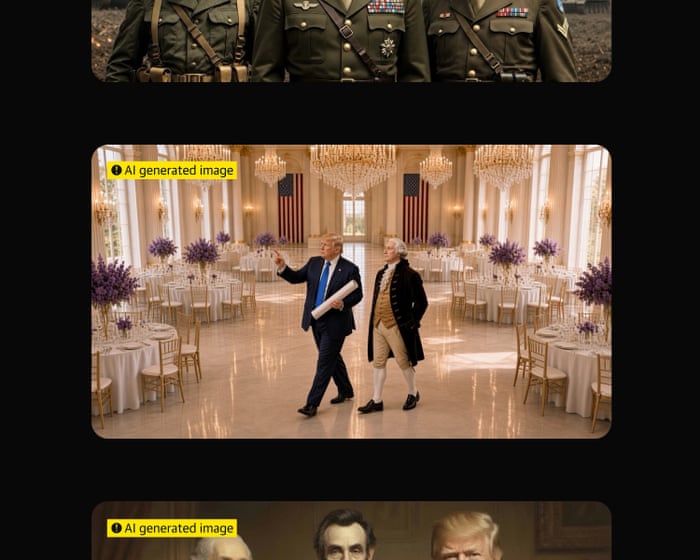
The Guardian reports that President Donald Trump has posted a series of images on his social media platform that the article describes as AI-generated and that depict him alongside prominent historical American figures (the piece explicitly invokes George Washington). The article places those posts in political context — noting low approval ratings in his second term and ongoing difficulty ending the war with Iran — and interprets the images as part of a deliberate image-management strategy. The Guardian provides no primary metadata in the supplied excerpt to independently verify the images' provenance nor direct statements from the president or his staff explaining intent; the article mixes reported facts with interpretive framing.
Source and Framing Analysis
Source: The Guardian (article headlined with a critical, interpretive tone). What it reports: that the president posted images described as AI-generated showing himself with historical American figures. Framing: the piece links those posts to political pressure (reported low approval ratings) and an unresolved foreign-policy conflict (the war with Iran) and characterizes the posts as a gambit to shape perception. Uncertainties and limits: the supplied excerpt does not show metadata or forensic verification proving AI provenance, does not include timestamps or platform-details in the excerpt, and does not quote the president or aides about intent. The article therefore moves from reporting observable posts (as it states them) to an interpretive claim about motive and effect; readers should separate the reported postings from the author’s interpretation about why they were posted and what impact they achieved.
How sources covered this story
Sanctuary separately assesses reporting quality and alignment with Christian virtues. The virtues assessment considers truthfulness, dignity, compassion, justice, peacemaking, humility, and care for vulnerable people. It does not assess a publisher's faith or reward religious language.
Compare 1 reports
Reporting 72/100Virtues 60/100
- Distinctive contribution
- States that the president posted AI-generated images of himself with key historical American figures (mentioning George Washington), and frames this as a deliberate use of imagery amid political trouble.
- Framing
- The piece frames the posts as a deliberate image-management gambit — somewhat critical and interpretive rather than purely descriptive — suggesting the social-media images are being used to distract or bolster standing during policy and approval crises.
- Omissions or uncertainty
- Excerpt lacks dates, platform details (where the images were posted), direct examples or links to the images, confirmation/provenance that the images are AI-generated, attribution or quotes, numerical approval-rating data, and specific evidence linking the posts causally to political strategy or effects.
- Why these scores
- The excerpt concisely conveys a relevant, newsworthy claim and situates it in context, but provides no sourcing, examples, quotes, or evidence in the supplied text to substantiate the assertion that images are AI-generated or to quantify approval-rating claims. The critical framing in the headline is strong; the body excerpt is clear but limited in specificity and attribution. The reporting is not dehumanizing and attempts to identify political behavior, which supports truth-telling and accountability. However, the headline's pejorative language ('AI slopper in chief') and the interpretive, potentially dismissive framing reduce scores for humility and respect. The excerpt does not display explicit compassion or restorative context.
Biblical Reflection
A Christian response distinguishes factual reporting from moral reflection. Factually, report and verify: determine what was posted, when, and by whom. Morally, attend to truthfulness, humility, and the welfare of vulnerable persons affected by policy decisions. The church should resist cynicism while exercising discernment: test motives, insist on honest public discourse, and prioritize care for those harmed by war or weakened civic institutions. Christians can model alternatives to spectacle — honest storytelling, accountability carried out with civility, and concrete acts of mercy and peacemaking — remembering that leadership oriented toward self-exaltation conflicts with the biblical call to servant-hearted responsibility.
Scripture in context
- 1Philippians 2:3-11 — An early Christian exhortation that models humility and self-giving as the pattern for communal and leadership life, contrasting self-exaltation with sacrificial service for others. — Leaders and citizens should measure political self-presentation against the call to prefer the welfare of others and to avoid self-glorifying postures; public images that elevate a leader invite the church to ask whether they reflect sacrificial service or self-promotion.
- 2Ephesians 4:25 — An instruction about truthful speech and communal integrity, urging believers to put away falsehood and to speak truthfully to one another. — In an era when images can be fabricated or manipulated, Christians are called to extra diligence in verifying and communicating truth. Promoting honest public discourse and resisting misleading representations are part of faithful witness.
Faithful Response
Pray for leaders, for peacemaking, and for those harmed by conflict.
Exercise discernment and media literacy: verify the provenance of viral images before sharing; ask for metadata or credible forensic analysis when possible.
Hold public officials accountable with civility: prioritize questions about policy substance (e.g., plans to end conflict, humanitarian responses) over commentary on imagery alone.
Equip congregations: offer teach-ins on recognizing manipulated imagery, organize practical support for refugees or military families, and create pastoral spaces for those anxious about civic instability.
Model humility and truth in public speech: avoid contributing to spectacle and emphasize care for vulnerable neighbors in advocacy and ministry.
Reflection and Discussion
- 1How does the use of AI-crafted images by a political leader affect our ability to discern truth in public life?
- 2Does this kind of image-making shift attention away from real human costs (such as people harmed by war), and if so, how should Christians respond?
- 3What posture of humility, truth-telling, and peacemaking should we expect from leaders, and how should our congregations encourage it?
Sources
Reporting links are evidence inputs; Sanctuary News' biblical reflection is commentary.
This outlook currently relies on fewer than two linked sources. Broaden verification before teaching from it.
- 1.AI slopper in chief: Trump turns to social media amid tough questionsprimary_reporting