News Summary
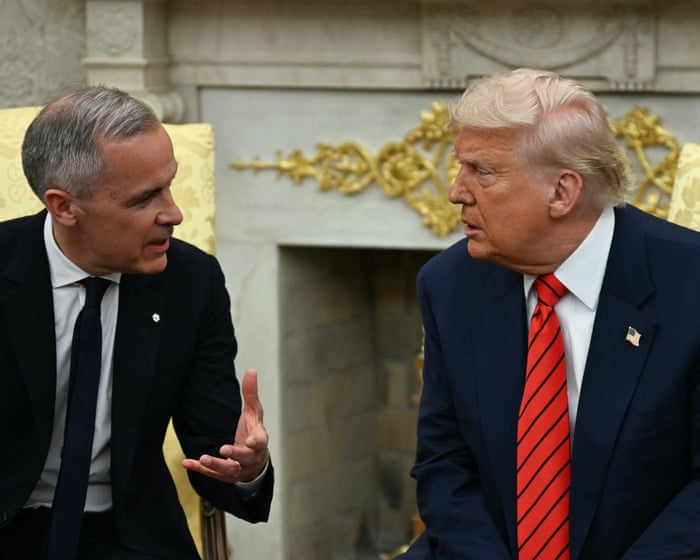
The Guardian reported that U.S. President Donald Trump paused a threatened punitive tariff on Canada hours before it was due to take effect. The article attributes a remark that "substantial progress" had been made toward a trade deal to the Canadian prime minister and places the pause in the context of a year of tit‑for‑tat tariffs and public criticisms between the two countries. The piece also cites a 2024 bilateral trade estimate of roughly $909 billion (attributed in the article to the Office of the U.S. Trade Representative). The report is a short newsletter item and omits official White House text or detailed description of the concessions or steps said to have produced "substantial progress." The article also appears to misidentify the Canadian prime minister, which raises a factual concern about attributions in the brief.
Source and Framing Analysis
Source: The Guardian newsletter brief. Framing: presented as an "11th‑hour backdown" and situated within a larger narrative of a contentious year of reciprocal tariffs and public broadsides. Strengths: timely, highlights an immediate diplomatic de‑escalation and the high economic stakes of U.S.–Canada trade. Weaknesses and uncertainties: the item is a short newsletter summary that provides no direct White House statement or official document text, gives no details on what constituted the reported "substantial progress," and appears to misname the Canadian prime minister—an attribution that conflicts with public records and undercuts confidence in the piece's accuracy for named claims. The newsletter format mixes unrelated items (electoral notes, cultural lines), which compresses context and increases the risk of sloppiness. For responsible coverage and analysis, corroborating official statements, the tariff instrument or order text (if any), and on‑the‑record Canadian statements is needed.
How sources covered this story
Sanctuary separately assesses reporting quality and alignment with Christian virtues. The virtues assessment considers truthfulness, dignity, compassion, justice, peacemaking, humility, and care for vulnerable people. It does not assess a publisher's faith or reward religious language.
Compare 1 reports
Reporting 58/100Virtues 62/100
- Distinctive contribution
- Provides a specific timing detail (an 11th-hour pause 'just hours before' the tariff would take effect) and attributes an official characterization of 'substantial progress' toward a trade deal to the Canadian prime minister; it also frames the move as part of a broader pattern of 'tit-for-tat' tensions.
- Framing
- Frames the pause as an '11th-hour backdown' within a contentious year between the two countries, using phrases like 'tit-for-tat tariffs' and noting online broadsides and provocations; the tone tilts toward adversarial context rather than neutral description. The excerpt also mixes in unrelated cultural and electoral lines (television vampires; Byron Donalds) that create a somewhat scattered brief-newsletter style.
- Omissions or uncertainty
- No sourcing or direct quote is provided for the claim that the tariff was paused beyond the paraphrase; the excerpt does not specify whether the pause is temporary or permanent, nor does it give details of what 'substantial progress' entails. It names individuals (the Canadian prime minister, identified here as 'Mark Carney', and Byron Donalds in a separate electoral reference) without sourcing or context. No dates, official documents, or statements from US officials are included in the supplied text.
- Why these scores
- The excerpt delivers a clear, timely claim that is likely newsworthy and offers useful context, which is appropriate for a newsletter brief. However, the supplied text shows signs of sloppiness or imprecision: it makes assertions about named officials without sourcing or supporting detail, mixes unrelated items in quick succession, and lacks clarity on the permanence or terms of the tariff pause. These weaknesses reduce reliability and lower the score despite the piece's utility as a brief update. The tone is neutral-to-critical and not dehumanizing; it treats nations and actors as political actors rather than reducing people to stereotypes, which aligns reasonably with truthfulness and human dignity. However, the excerpt's apparent factual imprecision and lack of careful sourcing weaken its contribution to truthful and responsible reporting. It does not demonstrate explicit compassion, justice-focused analysis, or restorative framing, so it earns a moderate score.
Biblical Reflection
A Christian outlook calls for truthfulness in reporting and representation, mercy toward those who bear the costs of political decisions, and active peacemaking where conflict threatens ordinary people. When trade threats and counter‑measures are used as leverage, Christians should press leaders for transparent reasoning and fair process, advocate for protections for vulnerable workers and communities who depend on cross‑border commerce, and seek de‑escalation that minimizes harm. This stance holds leaders accountable without demonizing individuals, prioritizes the dignity of those affected, and pursues justice through informed civic engagement and compassionate care for neighbors on both sides of the border.
Scripture in context
- 1Matthew 5:9 (the Beatitudes, 'peacemakers') — Beatitudes and the call to be peacemakers in a world of conflict. — This passage encourages Christians to favor de‑escalation, pursue reconciliation where possible, and support policies that reduce harm to vulnerable people rather than celebrate partisan triumphs.
- 2Micah 6:8 (requirements of justice, mercy, humility) — The prophetic demand for justice, mercy, and walking humbly before God as a guide for public life. — This passage prompts believers to ask whether policy pressures and negotiating tactics serve justice for ordinary people and reflect humility in the use of power.
Faithful Response
Pray specifically for negotiators, for leaders' wisdom, and for workers and small businesses reliant on cross‑border trade.
Seek primary documents and official statements (White House announcement or order, text of any tariff measure, and Canadian government statements) before drawing firm conclusions; correct reporting errors when identified.
Support local people likely affected by trade disruption (farmers, manufacturers, logistics workers) through church benevolence funds, referral lists, and practical assistance.
Encourage public officials to publish clear, verifiable explanations of policy steps and timelines and advocate for transparency in negotiations.
Model non‑partisan compassion in congregation communications—hold leaders accountable for truth and fairness while avoiding dehumanizing rhetoric about political opponents or foreign neighbors.
Reflection and Discussion
- 1How does my faith shape the sources I trust and the way I evaluate leaders' claims about negotiations?
- 2When national interest is invoked, how do I weigh that against the well‑being of cross‑border neighbors who may suffer the consequences of tariffs?
- 3What practical steps can our congregation take to care for people in our community who depend on stable international trade?
- 4How should Christians respond when media reports contain apparent factual errors about named officials or events?
Sources
Reporting links are evidence inputs; Sanctuary News' biblical reflection is commentary.
This outlook currently relies on fewer than two linked sources. Broaden verification before teaching from it.
- 1.First Thing: Trump in Canada tariff backdown after ‘substantial progress’ made on trade dealprimary_reporting