News Summary
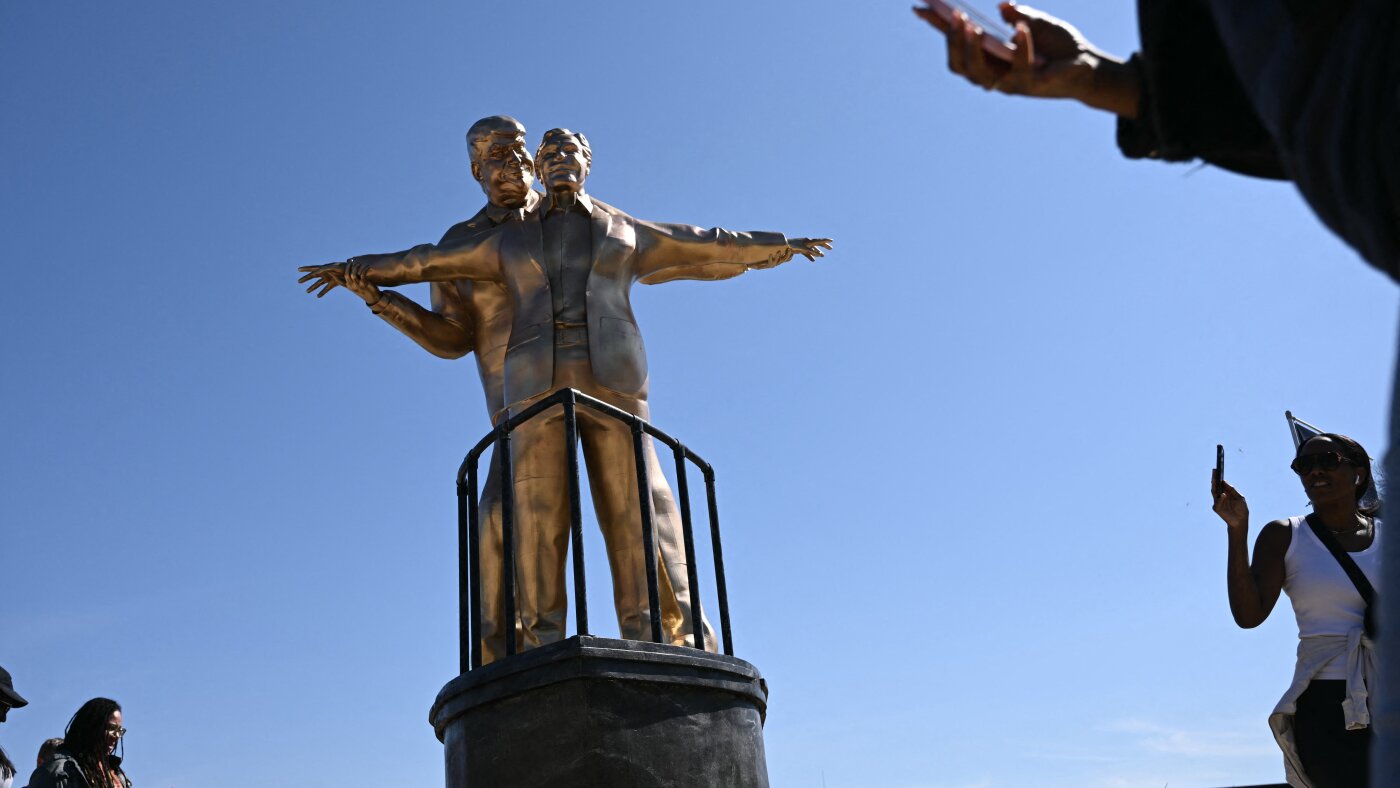
Federal buildings and cultural institutions on and near the National Mall have become a site of competing public imagery. The Trump administration has displayed large banners featuring President Trump's face on several federal buildings and affixed his name to sites including the John F. Kennedy Center for the Performing Arts and the United States Institute of Peace. In response, private groups and anonymous artist collectives have installed satirical artworks and posters around the Mall. The Secret Handshake installed temporary satirical statues (including a gold-painted piece riffing on the Titanic scene—titled “King of the World”—that included imagery linking Trump and the late convicted sex offender Jeffrey Epstein, and a faux-marble, gold-painted toilet sculpture called “A Throne Fit For a King”), while the Save America Movement put up posters mocking Cabinet members. Organizers of the protests defend ridicule as a political tactic; the White House says the banners reflect the president’s work and that organizations are free to voice opinions. Visitors and observers expressed mixed reactions: some found the artworks disrespectful, while others compared the administration's banners to personalized political iconography seen in authoritarian states. The article documents the visual confrontation and quotes proponents and critics on both sides.
Biblical Reflection
This story highlights how images and public spaces shape civic imagination. Biblically, Christians are called both to speak truth and to do so in ways that reflect Christlike character (Ephesians 4:15). Two temptations appear on display: the temptation to idolize leaders by elevating their image above healthy civic critique, and the temptation to dehumanize opponents through ridicule and scandal-focused mockery. Both can harden public discourse and make repentance, persuasion, and reconciliation harder. The article largely reports actions and reactions but leans into charged language (e.g., “propaganda war,” comparisons to authoritarian iconography) that frames the confrontation as a moral equivalence between official self-promotion and satirical attack. Christians should note that while satire and protest are legitimate expressions in a free society, truthfulness matters: allegations or insinuations should be supported by facts and distinguished from purely performative spectacle. At the same time, state use of public resources for partisan self-promotion raises genuine ethical questions about stewardship and the proper role of government presentation in civic spaces. The shape of Christian witness in such moments is to champion truth, pursue justice, and model charity—speaking up where abuses occur, but doing so without delight in shaming or slander, and recognizing the dignity of all people, even those with whom we strongly disagree.
Scripture in context
This outlook does not yet include contextual Scripture citations. Do not treat a general biblical theme as an exegetical conclusion.
Faithful Response
No prescribed response is offered. Consider the reflection prompts below in your own church context.
Reflection and Discussion
- 1What assumptions or framings in the article push you toward seeing one side as morally equivalent to the other, and where might those equivalences break down on the facts?
- 2How can Christians balance robust critique of public leaders with the call to preserve dignity and avoid slander or excessive ridicule?
- 3What standards of stewardship and neutrality should govern the use of taxpayer-funded public spaces for political imagery, and how should Christians advocate for those standards?
Sources
Reporting links are evidence inputs; Sanctuary News' biblical reflection is commentary.
This outlook currently relies on fewer than two linked sources. Broaden verification before teaching from it.
- 1.Original reportprimary