News Summary
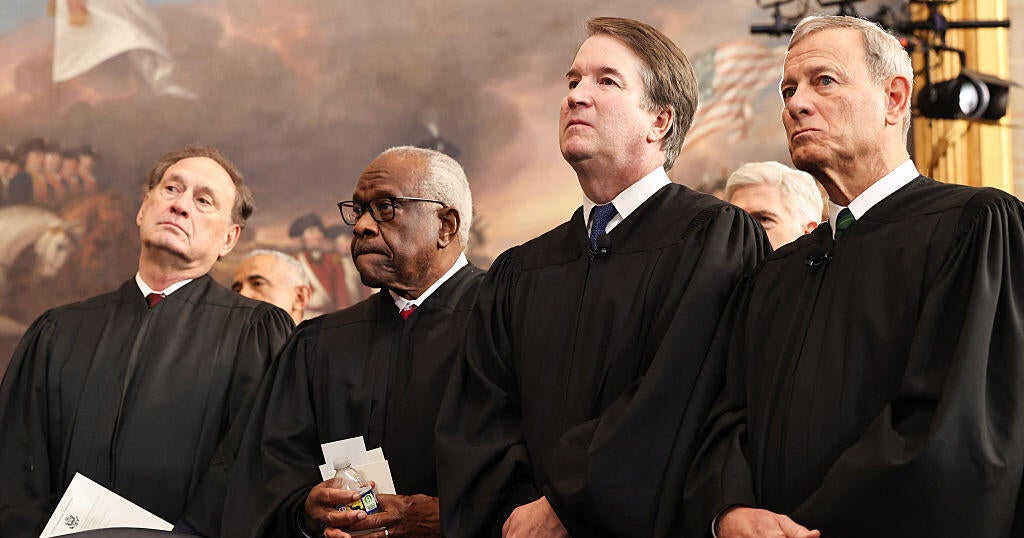
The U.S. Supreme Court issued final decisions for its 2025–2026 term affecting several policies tied to President Trump. Major rulings included: striking down statutory protections that limited the president's ability to remove members of independent agencies (Trump v. Slaughter); narrowing the reach of Section 2 of the Voting Rights Act and overturning a Louisiana congressional map (Louisiana v. Callais); upholding state bans on transgender girls and women competing in girls' and women's sports (West Virginia v. B.P.J.; Little v. Hecox); allowing the administration to end Temporary Protected Status for hundreds of thousands of Syrian and Haitian recipients by finding certain claims nonreviewable (Mullin v. Doe; Trump v. Miot); invalidating federal caps on coordinated campaign expenditures as violative of the First Amendment (NRSC v. FEC); rejecting the president's executive order to end birthright citizenship as inconsistent with the 14th Amendment (Trump v. Barbara); holding that the International Emergency Economic Powers Act does not authorize sweeping presidential tariffs (Learning Resources v. Trump); permitting Lisa Cook to remain a Fed governor while litigation over her removal proceeds (Trump v. Cook); upholding state policies that allow counting mail ballots arriving after Election Day if they were cast by Election Day (Watson v. RNC); and declining review of E. Jean Carroll's civil judgments against the president. The decisions produced a mix of outcomes: several rulings expanded presidential influence over parts of the executive branch and campaign finance freedoms, while others constrained presidential authority or protected established constitutional and statutory rights.
Biblical Reflection
From a Christian perspective, these rulings remind us that law and governance shape how power is exercised and how vulnerable people are treated. The Court’s decisions both strengthened executive control in some institutional areas and preserved restraints in others; they also reshaped protections affecting racial minorities, immigrants, women and transgender people. The article factually reports those outcomes but frames them largely as wins or losses for one political figure, which can over-simplify longer-term institutional and human consequences. Christians should notice two underlying dynamics: a legal reasoning that emphasizes either formal authority and majoritarian prerogative or the protection of rights and institutions, and political incentives that press courts and offices to resolve urgent social conflicts. Truth requires accurately weighing legal reasoning and consequences rather than partisan scorekeeping. Mercy and neighbor-love call us to consider who will be materially affected—the TPS recipients, voters in majority-minority districts, athletes, and those whose access to independent agencies or judicial review changes—and to advocate for policies and civic practices that protect the vulnerable, honor lawful institutions, and pursue justice with humility. Finally, Christians should resist letting allegiance to a political leader replace allegiance to biblical convictions about justice, stewardship of public institutions, and care for neighbors.
Scripture in context
This outlook does not yet include contextual Scripture citations. Do not treat a general biblical theme as an exegetical conclusion.
Faithful Response
No prescribed response is offered. Consider the reflection prompts below in your own church context.
Reflection and Discussion
- 1Which of these rulings strengthens institutional checks and which concentrates power, and how should that distinction shape our trust in government?
- 2Who are the most vulnerable people affected by these decisions, and how does Christian neighbor-love call us to respond to their needs?
- 3Are we assessing these outcomes by partisan advantage or by consistent biblical principles of justice, mercy, and the rule of law?
Sources
Reporting links are evidence inputs; Sanctuary News' biblical reflection is commentary.
This outlook currently relies on fewer than two linked sources. Broaden verification before teaching from it.
- 1.Original reportprimary