News Summary
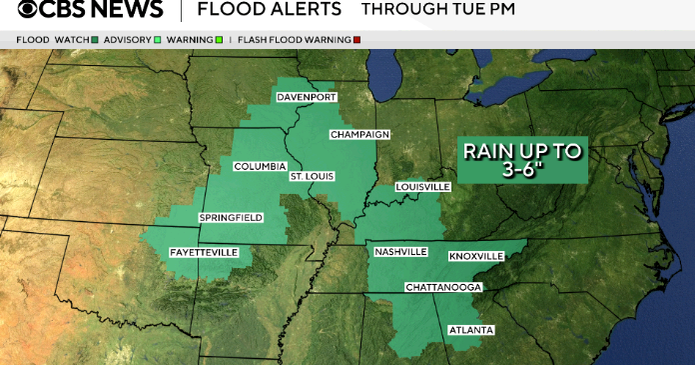
Forecasters say severe storms moving across the central United States this week could expose as many as 88 million people to some level of flooding risk. Flood watches covered large parts of the Midwest and extended south into Tennessee, northern Alabama, and Georgia; at the time of reporting about 20 million people were under flood watches. The National Weather Service warned of locally heavy rainfall (forecasted up to about 8 inches, with some areas recently receiving as much as 9 inches), flash flooding, very large hail, damaging wind gusts, and a few tornadoes across the central Plains and river valleys. Cities called out for elevated risk included Denver, Wichita, Kansas City and St. Louis; southwestern Missouri and northwestern Arkansas faced particularly high flood danger. Local incidents from recent storms included a flash flood emergency near Huntsville, Alabama, vehicles partially submerged and stranded drivers, multiple water rescues in Milam County, Texas, extensive tree damage and one fatality in New York City when a falling tree killed an 85‑year‑old man, and video-documented wind and flood damage in other locations. The article’s information is based on forecasts and official advisories and notes that watches indicate possible but not certain flooding.
Biblical Reflection
This report is primarily a factual weather advisory relying on National Weather Service forecasts; its aim is warning and preparation rather than persuasion. The numeric framing ("could impact more than 88 million") communicates potential scale but mixes possible exposure with actual, immediate watches (about 20 million), which can inflate perceived certainty if readers do not note the distinction between "could" and "will." From a Christian perspective, the article highlights two clear calls: first, to truth — we must read forecasts accurately, distinguishing modeled possibilities from confirmed events — and second, to neighbor‑love — many people face real, immediate danger and loss. The underlying worldview here is practical and precautionary: treat authoritative warnings seriously, prioritize protection of life, and mobilize community and institutional supports. The piece largely omits attention to which populations will be most vulnerable (elderly, low‑income, rural communities, those without insurance or transport), so readers should be alert to that blind spot. Christians are called to humility and mercy in the face of natural danger: prepare responsibly, support emergency responders, advocate for resources for vulnerable neighbors, and resist cynicism or fear. Reporting of deaths and rescues is sober and should prompt compassion rather than sensationalism.
Scripture in context
This outlook does not yet include contextual Scripture citations. Do not treat a general biblical theme as an exegetical conclusion.
Faithful Response
No prescribed response is offered. Consider the reflection prompts below in your own church context.
Reflection and Discussion
- 1Does the headline number ("could impact more than 88 million") reflect a modeled possibility or confirmed harm, and how does that shape our response to the news?
- 2Which communities are most likely to suffer disproportionately in these floods, and are their needs being named or met in public reporting?
- 3Are we allowing fear or resignation to replace practical preparedness and neighborly aid when warnings are issued?
Sources
Reporting links are evidence inputs; Sanctuary News' biblical reflection is commentary.
This outlook currently relies on fewer than two linked sources. Broaden verification before teaching from it.
- 1.Original reportprimary