News Summary
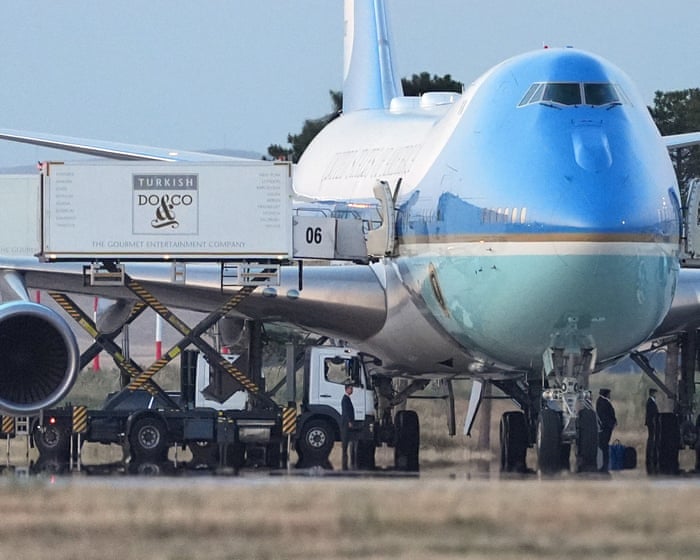
The Guardian published a summary of reporting by the Washington Post and the New York Times that U.S. intelligence last month assessed a credible plot by Iran to kill former president Donald Trump. Those reports say Trump was quietly moved off the publicly visible Air Force One onto a different plane while more than a hundred aides, officials and reporters remained on the original jet and were not informed of the alleged threat. The episode has prompted Democratic calls for a congressional briefing and public criticism that the press and the public were deliberately misled. Key operational details — who authorized movements, the precise nature and immediacy of the intelligence, and whether standard security protocols were followed — are reported as attribution to media accounts relying on unnamed sources and remain subject to confirmation.
Source and Framing Analysis
The Guardian piece in this cluster relays and summarizes reporting attributed chiefly to the Washington Post and the New York Times. The core factual claims are reported as coming from unnamed intelligence sources and officials in those original outlets; the Guardian itself does not publish primary-source documents in the supplied excerpt. Framing choices in the Guardian summary (words such as "charade," "decoy passengers," and "deliberately misled") reflect critics' judgments and political reaction as much as stated operational facts. Because the account relies on anonymous sourcing and secondary reporting, the story contains substantial uncertainty about operational authorization, the exact threat assessment, and security reasoning. Readers should therefore treat the central operational claims as attributed allegations awaiting independent corroboration and watch for official briefings or material evidence (e.g., agency statements, on-the-record interviews, or documents) that confirm or contest those accounts.
How sources covered this story
Sanctuary separately assesses reporting quality and alignment with Christian virtues. The virtues assessment considers truthfulness, dignity, compassion, justice, peacemaking, humility, and care for vulnerable people. It does not assess a publisher's faith or reward religious language.
Compare 1 reports
Reporting 76/100Virtues 79/100
- Distinctive contribution
- Confirms the ‘decoy’/charade narrative and reports that journalists and others remained on the publicized jet while Trump was secretly on another plane; records Democrats calling for a congressional briefing; states that US intelligence 'allegedly' found a credible Iranian plot and notes that Trump left Air Force One in a catering truck.
- Framing
- Critical and investigatory — describes the episode as a 'stunning charade,' emphasizes that reporters and the public were 'deliberately misled,' and highlights calls for oversight and accountability.
- Omissions or uncertainty
- The excerpt is brief and lacks sourcing detail (which intelligence agency made the threat assessment, what specific evidence supports the Iran plot claim), timing specifics, direct quotes or responses from Trump or the White House, and operational/security context explaining why journalists remained on the public jet. The use of 'allegedly' indicates uncertainty about the intelligence claim but no supporting detail is provided in the excerpt.
- Why these scores
- For a short excerpt it responsibly attributes the initial reporting to other outlets (Washington Post and New York Times), uses cautious language ('allegedly'), and notes political responses, which is appropriate. It is limited by brevity and lack of specific sourcing or documentary detail in the supplied text, but the tone and attribution are measured and not sensationalistic. The excerpt seeks truth and accountability (reporting an alleged deception and recording calls for a congressional briefing) and uses cautious language rather than asserting unproven facts. It avoids dehumanizing language and centers public-interest concerns. The score is moderated because the excerpt does not include perspectives from those accused nor detailed evidence, limiting fuller compassionate or restorative framing.
Biblical Reflection
From a Christian perspective, the story raises two overlapping concerns: stewardship of public trust and protection of vulnerable people. Leaders have a moral responsibility to protect those under their authority; secrecy that needlessly endangers staff, journalists, or the public violates obligations of care and honesty. At the same time, Christians should pursue truth patiently and fairly: press for transparent, accountable investigation rather than rushing to judgment. A faithful Christian response presses for verified facts and appropriate oversight while modeling mercy, humility, and concern for the dignity and safety of all affected.
Scripture in context
- 1Ephesians 4:25 — Paul's instruction to the church at Ephesus stresses truthful speech and ethical conduct within a community. — The exhortation to put away falsehood calls Christians to press for honesty from leaders and institutions; when public deception may have risked others' safety, the church's witness should include measured demands for truth and accountability.
- 2Matthew 5:9 — In the Sermon on the Mount Jesus blesses peacemakers and calls followers to pursue peace amid conflict. — The call to be peacemakers reminds Christians to seek truth in ways that reduce harm, to resist inflaming division, and to support constructive oversight and reconciliation processes that restore trust.
Faithful Response
Pray for investigators, security personnel, journalists, the former president, and all potentially endangered people—asking for wisdom, protection, and truthful disclosure.
Advocate for measured, documented oversight (for example, a congressional briefing or classified briefing where appropriate) so that responsibilities and decisions are clarified on the public record.
Avoid amplifying unverified allegations; encourage congregants to wait for corroboration from multiple independent sources before treating contested operational details as settled fact.
Support institutions that protect journalists and hold public officials accountable, while resisting partisan exploitation of genuine safety concerns.
Provide pastoral care for congregants who feel anxious or betrayed by public institutions; model humility, restraint, and care for vulnerable neighbors while seeking justice.
Reflection and Discussion
- 1How does Scripture shape the way I demand accountability from leaders while preserving charity toward individuals?
- 2When secrecy is argued for on safety grounds, what standards of disclosure should Christians insist public officials meet to protect neighbors?
- 3Am I contributing to the spread of unverified allegations? How can I better steward truth in my community?
- 4How can my congregation pray and act to protect vulnerable people affected by possible abuses of secrecy or negligence?
Sources
Reporting links are evidence inputs; Sanctuary News' biblical reflection is commentary.
This outlook currently relies on fewer than two linked sources. Broaden verification before teaching from it.
- 1.Trump’s Air Force One deception faces scrutiny over ‘decoy’ passengersprimary_reporting