News Summary
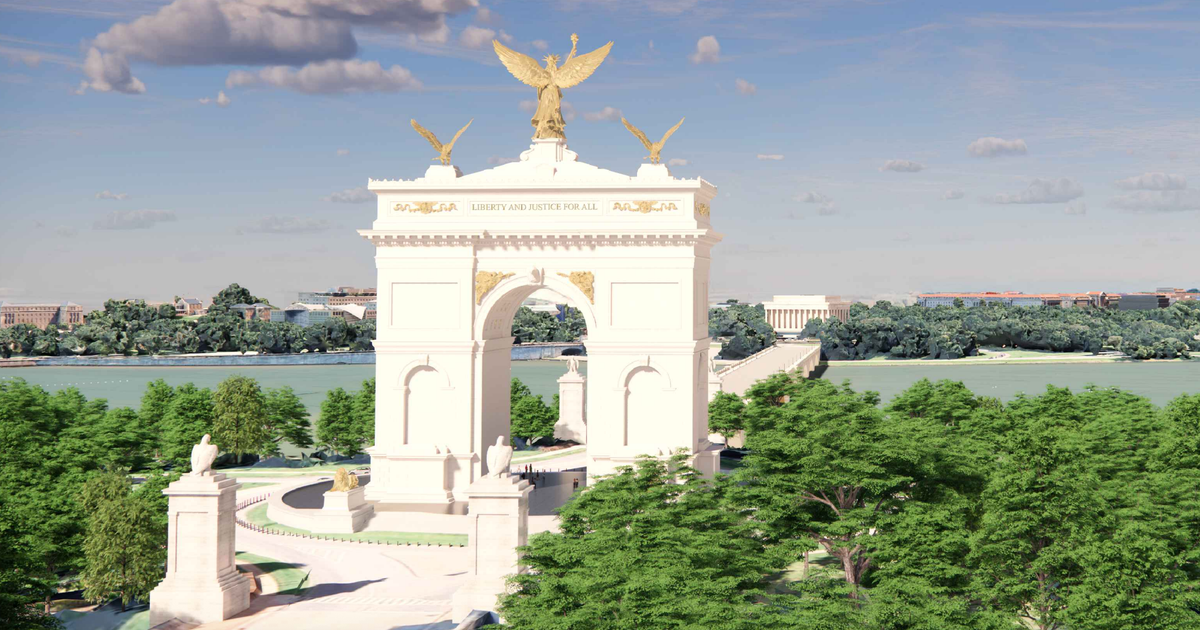
A federal design review commission with members appointed by President Trump gave preliminary approval to plans for a 250-foot stone arch proposed for Columbia Island in the Potomac River near the Lincoln Memorial and Arlington National Cemetery. The architect, Nicolas Charbonneau, was questioned about structural footings, pedestrian and wheelchair access, an underground tunnel, the golden statues (a gold-plated bronze Lady Liberty, two bald eagles, and two lions), and other details. Interior Secretary Doug Burgum presented the project, citing a more-than-century-old plan that originally called for 160-foot columns on Columbia Island and saying the new arch’s supporting columns would roughly match that height. Commissioner James McCrery, who voted for preliminary approval, suggested design changes including reducing the height (he noted ~166 feet might be more appropriate), enlarging the doorway, and removing the tunnel. The design includes an elevator-accessible observation deck and bollards. The commission received about 1,000 public comments; the commission secretary read that public comments were uniformly opposed. A group of Vietnam War veterans has filed suit seeking to block construction on the grounds that the arch would obscure the visual connection between the Lincoln Memorial and Arlington National Cemetery; a judge has not yet blocked the project. The architect may revise plans before the commission votes on final approval.
Biblical Reflection
This story raises questions about stewardship of public memory, the proper use of civic space, and how political power shapes monuments. The project was advanced through a commission with members chosen by the sitting president and highlights a recurring tension: large public works can be presented as historic or civic improvements while also serving as vehicles for a political figure’s legacy. Objectively, the article reports questions raised about safety, access, scale, and public opposition, and it notes a pending lawsuit by veterans—facts that point to real procedural and ethical concerns. From a Christian perspective, we should weigh the goals and impacts: does this monumenting honor the dignity of those memorialized and the grief of veterans, or does it risk centering a living political personality above shared civic memory? Scripture calls God’s people to humility, truth, and care for the vulnerable; here that includes listening to veterans and the public, avoiding the idolization of leaders, and exercising careful stewardship of civic spaces entrusted to all citizens. Christians should be wary of tribalizing memory or using grand architecture to consolidate political prestige, while advocating for processes that are transparent, just, and attentive to those most affected.
Scripture in context
This outlook does not yet include contextual Scripture citations. Do not treat a general biblical theme as an exegetical conclusion.
Faithful Response
No prescribed response is offered. Consider the reflection prompts below in your own church context.
Reflection and Discussion
- 1Who is served by this monument — the public’s shared memory or an individual’s legacy?
- 2Does the proposal respect the sacred visual and emotional relationships among existing memorials and the people they honor?
- 3Are decision processes open and attentive to those most affected, especially veterans who say the structure would harm their memorial?
Sources
Reporting links are evidence inputs; Sanctuary News' biblical reflection is commentary.
This outlook currently relies on fewer than two linked sources. Broaden verification before teaching from it.
- 1.Original reportprimary