News Summary
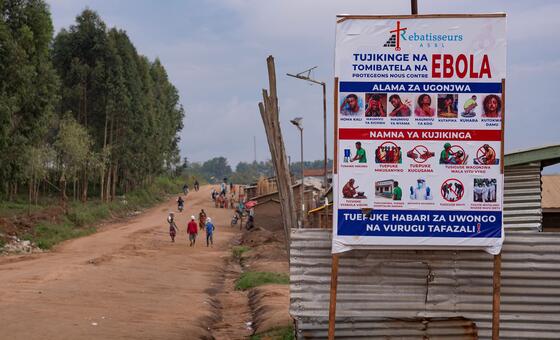
UN News reported that the World Health Organization (WHO) outlined a large community-engagement push in response to the ongoing Ebola outbreak in the Democratic Republic of the Congo and suggested that motorbike riders who transport sick people could help improve outreach and access to care. The dispatch placed that announcement a day after an ambulance attack in the affected area. The reporting is based on a single UN News piece summarizing WHO statements and does not supply epidemiological data, operational details, independent confirmation of the security incident, or extensive local perspectives.
Source and Framing Analysis
The story rests on a single UN News dispatch that attributes the operational suggestion (greater community engagement and using motorbike riders) to WHO. UN News framed the item as 'from the frontlines' and used emphatic language (including a description of the outbreak as 'deadliest-ever') that conveys urgency and scale but is not supported in the excerpt by epidemiological figures or multi-source corroboration. Source-specific attributions: WHO is the origin of the proposed operational shift toward community-based transport; UN News is the publisher that linked that proposal to recent security pressures (an ambulance attack). Framing effects and limitations: the account highlights an adaptive, community-centered response to constrained formal transport, which is useful context for humanitarian planning, but it omits key operational details (training, infection-control protocols, funding, consent of motorbike riders), lacks local voices, and does not independently corroborate the ambulance attack. Because reporting relies on one outlet summarizing WHO, practical feasibility and safety remain under-specified and should not be assumed without further confirmation from field actors, local authorities, and additional reporting.
How sources covered this story
Sanctuary separately assesses reporting quality and alignment with Christian virtues. The virtues assessment considers truthfulness, dignity, compassion, justice, peacemaking, humility, and care for vulnerable people. It does not assess a publisher's faith or reward religious language.
Compare 2 reports
Reporting 80/100Virtues 80/100
- Distinctive contribution
- Reports that WHO is leading/announcing a 'massive push' for community engagement and notes recent attacks on ambulances, implying security challenges and a shift toward community-based approaches (motorbike riders implied by title).
- Framing
- Field-focused, response-oriented: frames the story around frontline response efforts and security incidents that complicate traditional medical transport, suggesting adaptation toward community engagement and alternative transport/triage solutions.
- Omissions or uncertainty
- No specifics on what the 'massive push' entails, who is organizing it on the ground, scale or locations, no data on how frequent ambulance attacks are or their impacts, no direct quotes or numbers; the supplied excerpt relies on WHO attribution but lacks detail.
- Why these scores
- Clearly attributed to WHO and situates the report 'from the frontlines'; links programmatic response (community engagement) to operational constraints (ambulance attack). The piece is concise and appropriate for a news brief; missing operational specifics reduce depth but not accuracy. Highlights efforts to engage communities and the safety risks faced by responders, which aligns with concern for human dignity, protection of the vulnerable, and pragmatic care. The excerpt treats the subject respectfully and responsibly; higher score limited by lack of detail on humanitarian impacts or aid measures.
Reporting 78/100Virtues 75/100
- Distinctive contribution
- Confirms the outbreak has passed a 100-day mark and conveys UN agencies' assessment that the epidemic is unprecedented in scale and requires expanded containment efforts, including across borders.
- Framing
- Urgent public‑health warning: frames the situation as an unprecedented-scale epidemic that requires escalation of response to contain spread regionally and across borders.
- Omissions or uncertainty
- No case or death counts, geographic specificity beyond 'eastern region' and 'across borders', no named UN agencies beyond 'UN agencies', no description of response measures or local conditions; timing limited to 'on Monday' without a date.
- Why these scores
- Concise and transparently attributed to 'UN agencies', provides a clear time marker and high-level assessment appropriate for a brief news update. Lacks quantitative detail and specificity about which agencies, exact locations, and data, which limits utility for in-depth analysis but does not mislead. The wording stresses protection and containment, signalling concern for public safety and vulnerable populations; it is not dehumanizing and attributes warnings responsibly. Score moderated because the excerpt lacks explicit references to humanitarian needs, affected communities, or calls for assistance.
Biblical Reflection
Practical public-health creativity in a violent context can save lives: when formal ambulance services are disrupted, trusted local transport networks such as motorbike riders may be vital to getting sick people to care. From a Christian perspective this raises two urgent moral claims: protect vulnerable patients and caregivers, and empower humble, neighbor-led service that meets people where they are. Christians should support life-preserving, community-centered responses while insisting on transparency, safety, and respect for local leadership. Mercy motivates engagement; justice and peacemaking call for durable protection of health workers and patients so care can proceed without fear. In all engagement, humility and care for human dignity should govern partnerships with local communities, ensuring responses do not expose volunteers to undue risk or undermine local capacity.
Scripture in context
- 1Luke 10:25-37 (Good Samaritan) — Gospel instruction on concrete mercy toward vulnerable strangers who have been harmed. — The passage calls Christians to practical, cross-cultural compassion: to value concrete aid (transport, care, protection) over distant judgment. It challenges faith communities to support responders who risk danger to help others and to remove obstacles that prevent care.
Faithful Response
Pray specifically for the sick, caregivers, motorbike riders, and communities affected by the outbreak; ask for protection, wisdom, and conversion away from violence that obstructs care.
Support reputable humanitarian and medical organizations already working in the DRC, prioritizing programs that are community-led and that protect both patients and responders.
Advocate with humility to diplomatic and humanitarian actors for safe passage and funding for protective measures (PPE, training, secure transport protocols) rather than publicity-focused interventions.
Listen to and defer to local leaders and health authorities; avoid sending uncoordinated volunteers or solutions that could undermine local capacity or increase risk.
Insist on accountability and transparency from agencies proposing new operational models: request clear plans for recruitment, training, infection-control measures, compensation, and legal protections for motorbike riders if they are engaged as part of the response.
Reflection and Discussion
- 1Who counts as a 'neighbor' and a legitimate first responder in contexts of fragility and violence, and how should that shape our aid priorities?
- 2What must be true—about training, infection prevention, consent, compensation, and security—before motorbike transport is scaled up safely?
- 3How can churches and Christian organizations support community-led responses without imposing external control or increasing risk to local volunteers?
- 4What practical steps should we press for to protect health workers and patients from violence while preserving community access to care?
Sources
Reporting links are evidence inputs; Sanctuary News' biblical reflection is commentary.
This outlook currently relies on fewer than two linked sources. Broaden verification before teaching from it.
- 1.Ebola: Motorbike riders carrying the sick may hold key to response boostofficial_document