News Summary
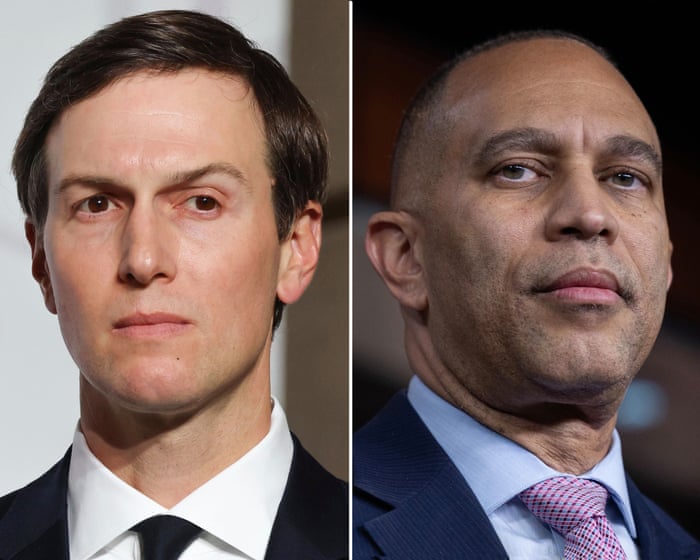
A New York Times report, as relayed by The Guardian, says House Democratic leader Hakeem Jeffries met privately with Jared Kushner to discuss 'possible areas of collaboration.' The Guardian first published coverage noting incredulous reactions from Democrats and Trump critics—named in that account as Senator Chris van Hollen, Tommy Vietor, and Adam Kinzinger—and placed the meeting months ahead of November midterm elections, when Democrats could retake the House and exercise oversight. A subsequent Guardian item quotes Jeffries defending the encounter, saying he agreed to meet to discuss the 'affordability crisis' and that the meeting was arranged at Kushner’s request. The reporting provides no detailed chronology, location, attendee list beyond the two principals, or direct responses from Jared Kushner in the supplied material.
Source and Framing Analysis
Primary attribution: The core factual claim (that the meeting occurred) is reported in the New York Times and is relayed by The Guardian. The Guardian’s coverage frames the item around intra‑party surprise and political risk, foregrounding critics’ incredulity and tying the meeting to the political stakes of upcoming midterm elections and prospective congressional oversight. A later Guardian piece furnishes Jeffries’ public defense and his account that Kushner requested the meeting and that they discussed affordability issues. Missing from the supplied coverage are independent corroboration of meeting details, direct statements from Kushner or the Trump camp, and documentary evidence about agenda or outcomes. Framing effects to note: emphasis on incredulity and political consequences increases perceptions of impropriety; presentation of Jeffries’ public explanation mitigates one side of the controversy but does not supply full verification. Readers should consult the original New York Times reporting and seek official statements or additional independent sources for fuller corroboration.
How sources covered this story
Sanctuary separately assesses reporting quality and alignment with Christian virtues. The virtues assessment considers truthfulness, dignity, compassion, justice, peacemaking, humility, and care for vulnerable people. It does not assess a publisher's faith or reward religious language.
Compare 2 reports
Reporting 82/100Virtues 82/100
- Distinctive contribution
- Lists specific critics (Sen. Chris van Hollen, Tommy Vietor, Adam Kinzinger) and connects the meeting to the political calculation about House control and future oversight, supplying context about potential conflicts of interest and consequences.
- Framing
- Frames the meeting as controversial within the Democratic coalition and as potentially inconsistent with anticipated oversight responsibilities if Democrats regain the House; emphasizes incredulity and political risk for Jeffries.
- Omissions or uncertainty
- Does not include Jeffries' own defense or Kushner/Trump responses in the supplied excerpt; the basis for critics' incredulity (specific objections) is not detailed beyond naming critics; no independent confirmation of the meeting's agenda or who requested it is provided in the excerpt.
- Why these scores
- The excerpt provides useful context and attribution (identifying critics and linking the report to a New York Times story), and explains the political significance in a way that helps readers understand stakes. It is judicious and specific for its purpose, though the supplied text omits counterstatements from primary parties. The account supports accountability (justice) by highlighting potential conflicts of interest and oversight responsibilities, and it names critics rather than engaging in anonymous insinuation (truthfulness/transparency). It avoids dehumanizing language and helps readers weigh public-interest implications, aligning well with virtues of justice and care for the common good.
Reporting 78/100Virtues 75/100
- Distinctive contribution
- Reports Jeffries' explicit claim that the meeting was arranged at Jared Kushner's request and that he agreed to meet to discuss the affordability crisis, providing the principal public explanation for the encounter.
- Framing
- Frames the story around Jeffries defending himself against criticism from his own party, emphasizing intra-party political backlash and presenting the meeting as an attempt to find bipartisan 'common ground' on issues like housing, immigration and cost of living.
- Omissions or uncertainty
- No quotation or response from Jared Kushner or the Trump camp is supplied; the excerpt does not show documentation beyond Jeffries' claim that Kushner requested the meeting; it lacks detail on what, if anything, was agreed; timing and location details of the meeting are not given; no evidence verifying who initiated the meeting beyond Jeffries' statement.
- Why these scores
- The excerpt attributes claims (references a New York Times report and Jeffries' statement), states the reporter's focus clearly, and uses specific issue areas. It is concise and cautious in wording. It is limited in scope — no Kushner comment or independent corroboration is provided in the excerpt — which prevents a higher score. The piece sticks to attributed claims and highlights a public official explaining his motives (truthfulness/humility). By focusing on affordability it touches on concerns for vulnerable people. It does not dehumanize subjects and does not sensationalize in the supplied text. Score is limited by lack of broader context about potential impacts on affected communities.
Biblical Reflection
Christians are called both to welcome constructive cooperation that advances the common good and to insist on transparency and accountability where conflicts of interest may arise. Practically, this story calls the church to press for clear disclosures about private meetings involving major political actors, support independent oversight where appropriate, and resist rushing to moral certainty without confirmed facts. Our response should center truth, mercy, justice, peacemaking, humility, dignity, and care for vulnerable neighbors: demand honesty and accountability while treating public actors with basic dignity and avoiding slander.
Scripture in context
- 1Proverbs 11:1 — Wisdom literature contrasts honest with dishonest dealings and highlights the communal consequences of integrity or corruption. — This story invites the church to insist on honest dealing and transparency in public life: cross‑partisan engagement can serve the common good, but must not be used to shield wrongdoing or to evade rightful scrutiny.
- 2Matthew 5:9 (Beatitudes) — Jesus blesses peacemakers and commends reconciliation as a mark of the kingdom. — Christians can encourage constructive engagement across partisan lines while also calling for accountability and protection of the vulnerable; peacemaking does not remove the prophetic responsibility to speak for justice.
Faithful Response
Pray for discernment for public leaders and for the church to witness faithfully. Seek verified information before forming judgments: request official statements, look for multiple independent confirmations, and monitor disclosures. Advocate for transparency and appropriate safeguards (clear disclosures, recusals where conflicts could arise) while treating political opponents and allies with dignity. Resist weaponizing incomplete reports; hold to principles of truth and restorative justice in civic life.
Reflection and Discussion
- 1How can Christians hold public leaders to account without falling into slander or premature condemnation when facts remain incomplete?
- 2When is political cooperation an act of peacemaking and when might it risk undermining oversight or enabling injustice?
- 3What institutional safeguards should we ask of leaders who meet privately with figures who may be subjects of congressional oversight?
- 4How should local congregations teach faithful citizenship in a moment when private political meetings provoke public suspicion?
Sources
Reporting links are evidence inputs; Sanctuary News' biblical reflection is commentary.
This outlook currently relies on fewer than two linked sources. Broaden verification before teaching from it.
- 1.Democrats incredulous over Hakeem Jeffries and Jared Kushner meetingprimary_reporting