News Summary
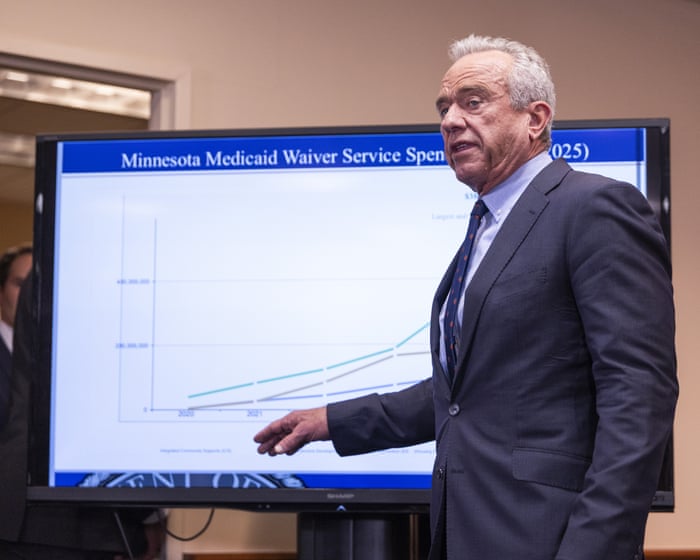
Reported facts: HHS Secretary Robert F. Kennedy Jr. announced at a press conference that the department has paused more than $1 billion in Medicaid funding to California and Minnesota, citing "suspected fraud and noncompliance," and referenced prior action earlier this year pausing $243 million to Minnesota. He said artificial intelligence was used to identify potential fraud in Democratic-run states and stated that states must document that payments are legitimate to receive the funds. Attribution and uncertainty: The claims about AI use and the exact breakdown of amounts per state are reported as statements made by Kennedy; the article provides no independent documentation of the fraud allegations, the AI methods, the legal authority invoked, or the immediate operational impact on beneficiaries.
Source and Framing Analysis
Material uncertainties that affect the story include: the lack of detailed breakdown of the more-than-$1 billion total between the two states, no description of the alleged fraudulent payments or programs affected, no technical explanation or third-party evaluation of the AI methods referenced, and no citation of legal statutes or formal notices that justify withholding federal Medicaid funds. The article also highlights the partisan label "Democratic-run states," which frames the action politically and may influence reader interpretation; this framing is part of the reporting but does not replace the need for documentary evidence and independent verification.
Biblical Reflection
This report raises two Christian concerns: truth-seeking and care for the vulnerable. Public officials have a duty to pursue fraud and misuse of public funds—stewardship and justice matter. At the same time, Medicaid is a primary safety net for low-income people, children, the elderly, and disabled neighbors; abruptly withholding funds risks harming those who rely on health care. Christians should hold both commitments together: insist on transparent, evidence-based accountability while resisting actions that shift costs onto the poor before due process and adequate safeguards are in place.
The article’s language and emphasis also reflect a political lens (noting "Democratic-run states") that may shape public perception of motive. Christians should be cautious about partisan assumptions and evaluate whether claims are documented and whether the methods (including AI) are reliable, unbiased, and audited. Where technology is invoked to make consequential determinations affecting people’s health, the moral demands of truth, fairness, and mercy require clear standards, independent review, and protections for those least able to absorb disruption.
Practically, this means advocating for transparent evidence, procedural safeguards, timely communication with affected communities, and immediate measures to prevent interruptions in care. The posture of a faithful listener is humble and vigilant: seek the facts, protect the weak, and call for processes that reflect both justice and compassion.
Scripture in context
- 1Isaiah 1:17 — Isaiah addresses a society where outward religion has not been matched by justice and care for the vulnerable; the prophet calls for learning to do right and defending the oppressed in a context of prophetic critique of social failure. — This passage calls Christians to insist on justice—exposing and correcting wrongdoing—while ensuring that the oppressed and needy are defended; in practice, that requires demanding fair investigative processes and protecting people who would suffer collateral harm.
- 2Luke 10:25-37 (Parable of the Good Samaritan) — Jesus tells a parable instructing a lawyer and broader hearers about who counts as a neighbor, using an example that upends social and ethnic expectations to teach active, compassionate mercy. — When policy actions risk harming those in need, the parable reminds Christians that love of neighbor requires practical care across political lines and that institutional decisions should be measured against their impact on vulnerable persons.
Faithful Response
Pray for evidence-based governance, for wisdom for investigators, and for protection for Medicaid recipients.
Seek reliable information: ask for transparent documentation of allegations, the legal basis for withholding funds, and independent audits of any AI systems used.
Support local clinics, food pantries, or Medicaid navigators that serve people who might lose access to care, and encourage congregational outreach to those affected.
Contact elected representatives to request oversight, clarity on safeguards, and measures to prevent interruptions in care pending resolution.
Reflection and Discussion
- 1What evidence would we require before accepting claims of systemic fraud that justify withholding funds crucial for health care?
- 2How should Christians evaluate the ethical use of AI in government enforcement, especially when errors could harm the least advantaged?
- 3In a polarized environment, how can we keep care for vulnerable neighbors central when debating government accountability?
Sources
Reporting links are evidence inputs; Sanctuary News' biblical reflection is commentary.
This outlook currently relies on fewer than two linked sources. Broaden verification before teaching from it.
- 1.RFK Jr pauses $1bn Medicaid funding to California and Minnesotaprimary_reporting