News Summary
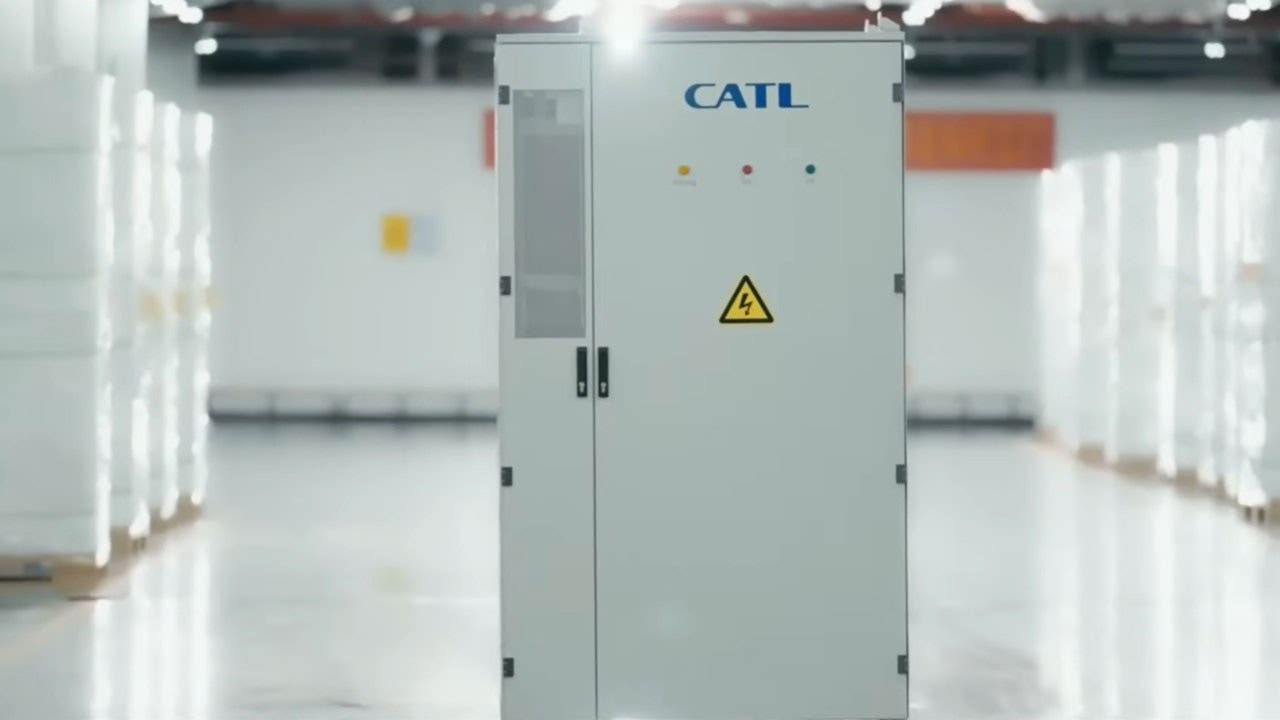
Chinese battery maker CATL unveiled the TENER Sodium Energy Storage System in Munich, calling it the world's first field‑validated commercial sodium‑ion energy storage system designed for stationary grid use. CATL says cumulative shipments will reach 1 gigawatt‑hour by end of 2026, with deliveries in China starting September 2026 and global deliveries beginning June 2027. The system is intended for large storage sites, offers >30 megawatt‑hours of rated capacity per installation, and uses modular units (each roughly 42 metric tons) so 34 modules would provide 1 GWh. CATL claims the TENER system is compatible with existing lithium iron phosphate (LFP) enclosures, supports multiple discharge durations (1–8 hours), and offers improved extreme‑temperature performance, enhanced safety (a stated 20% safety margin vs. lithium‑ion), lower auxiliary power use (1% vs. industry average 2%), reduced heat generation via a top‑discharge airflow design, and lower noise (65 dB). CATL reports investing about $1.4 billion in related R&D, expanding production at its Fuding site (+40 GWh annual capacity) and planning further capacity in Jining (160 GWh), and says it signed a three‑year, 60 GWh sodium‑ion order with HyperStrong in April 2026. The article notes CATL has not announced a U.S. launch and that U.S. utilities, regulators, and developers would need to evaluate cost, performance, supply‑chain, and security considerations. The piece frames sodium as far more abundant than lithium and positions sodium‑ion as another option (not an immediate replacement) for grid storage, while cautioning that a new battery chemistry will not by itself fix transmission, permitting, or local grid bottlenecks.
Biblical Reflection
The article presents a technology development with potential public good—greater grid flexibility and more material diversity in energy storage—but most claims come from the manufacturer and require independent verification and regulatory review. The underlying worldview emphasizes technological progress and market competition as solutions to infrastructure strain (driven in part by rising electricity demand from data centers and renewables). Christians should welcome innovations that can protect neighbors from outages and steward creation by enabling renewables, while also asking for prudence: verify corporate claims, guard against overreliance on a single foreign supplier in critical infrastructure, and consider justice for communities affected by siting and supply‑chain impacts. The reporting is informative but leans on company figures and promotional language without deep independent testing data; readers should note potential bias in relying on manufacturer statements and remember that technology alone does not address systemic issues like transmission upgrades, permitting delays, or geopolitical risk. Responding in Christian virtue means pursuing truth (demanding evidence), humility about technological limits, courage to strengthen domestic and international oversight, and mercy toward those harmed by power instability.
Scripture in context
This outlook does not yet include contextual Scripture citations. Do not treat a general biblical theme as an exegetical conclusion.
Faithful Response
No prescribed response is offered. Consider the reflection prompts below in your own church context.
Reflection and Discussion
- 1Whose claims and data are we trusting about this technology, and what independent testing or oversight is needed before it becomes critical infrastructure?
- 2How should concerns about supply chains and national security shape decisions about adopting foreign‑made grid components, even when they promise public benefits?
- 3Are we treating technological innovation as an automatic fix rather than one element among policy, investment, and community care when addressing energy reliability?
Sources
Reporting links are evidence inputs; Sanctuary News' biblical reflection is commentary.
This outlook currently relies on fewer than two linked sources. Broaden verification before teaching from it.
- 1.Original reportprimary