News Summary
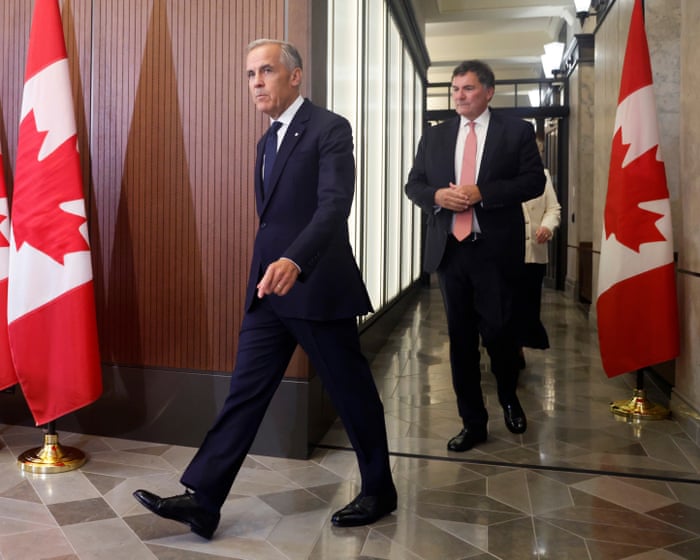
According to reporting in The Guardian, Mark Carney said Canada could not accept a proposed U.S. trade deal he believes would weaken legal protections for the French language in Quebec. The Guardian quotes Carney characterizing how American negotiators treated the French language as an “irritant,” and reports widespread praise for the Canadian prime minister’s rejection of the U.S. proposal. The article also records that President Donald Trump posted on social media accusing Canada of “ripping off” the United States and warning of possible new tariffs on cars and trucks. PBS NewsHour separately notes that negotiations recently broke down and aired expert discussion about the possible economic fallout on both sides of the border. The available reporting does not include the text of the disputed trade proposal, responses from U.S. negotiators, or independent economic analysis of the threatened tariffs.
Source and Framing Analysis
Primary reporting in this cluster comes from a single detailed Guardian article, with a short corroborating program summary from PBS NewsHour. The Guardian frames the dispute around protecting Francophone rights in Quebec and highlights political praise for Canada’s rejection of U.S. terms; it also reproduces the U.S. president’s social‑media tariff threat. Strengths: the Guardian names public figures (Carney, the prime minister, the U.S. president) and attributes direct characterizations and a quoted social‑media post. PBS corroborates that negotiations broke down and that public discussion of economic impacts followed. Limitations and framing cautions: the Guardian excerpt is the only source supplying the specific characterization that U.S. negotiators treated French as an “irritant” and the specific tariff threat; those claims are not independently sourced in the supplied material. Crucial primary materials are missing from the reporting provided here: the draft trade text or formal negotiation documents, direct statements or the text of remarks from U.S. negotiators, formal Canadian government texts explaining the legal rationale for rejection, and independent economic studies of the tariff threat. The Guardian excerpt also contains potential ambiguity in speaker attribution (references to Mark Carney and the prime minister without fully clear separation). Because the cluster relies primarily on one narrative source, readers should treat distinctive claims (especially evaluative language about economic devastation or the negotiators’ attitudes) as reported interpretations that need documentary corroboration.
How sources covered this story
Sanctuary separately assesses reporting quality and alignment with Christian virtues. The virtues assessment considers truthfulness, dignity, compassion, justice, peacemaking, humility, and care for vulnerable people. It does not assess a publisher's faith or reward religious language.
Compare 2 reports
Reporting 74/100Virtues 78/100
- Distinctive contribution
- Confirms a weekend breakdown in negotiations and that PBS aired a discussion (Geoff Bennett with CBC's Peter Armstrong) about economic consequences on both sides of the border.
- Framing
- Brief, neutral news-summary framing that presents the situation as an intensifying trade dispute and frames the item as a conversation about economic impacts.
- Omissions or uncertainty
- No specific details on what negotiations concerned or why they broke down; no dates, no direct quotes, no description of proposed measures (tariffs, scope, sectors) or economic estimates.
- Why these scores
- Concise and properly attributed (names the interviewer and guest) and serves as a clear program summary. It lacks substantive specifics and sourcing about the underlying claims, but that is appropriate for a short program description rather than an investigative piece. Neutral, non-inflammatory language that does not dehumanize parties and signals a constructive public-interest discussion about economic consequences. The excerpt shows respect for factual reporting without sensationalism.
Rank 2
The Guardian: Mark Carney says Canada can’t accept US trade deal that would weaken French languageReporting 66/100Virtues 72/100
- Distinctive contribution
- Introduces a cultural-linguistic dimension (French-language rights framed as 'rights' in Quebec), attributes a characterization of U.S. negotiators' view of French as an 'irritant,' and quotes Trump's social-media threat of broad tariffs on autos and trucks.
- Framing
- Sympathetic to Canadian resistance and critical of the U.S. negotiating posture; contains evaluative language (e.g., 'economically devastating') and highlights political praise for rejecting the U.S. proposal.
- Omissions or uncertainty
- Excerpt is fragmentary and slightly confusing in personnel references (mentions Mark Carney then 'the prime minister' without clear separation); lacks direct quotes from the prime minister or the U.S. negotiators' source; 'economically devastating' is asserted without supporting economic evidence in the excerpt; no dates or full context for the quoted social-media post.
- Why these scores
- Provides concrete, newsworthy claims and a direct quotation attributed to the U.S. president, which is valuable. The excerpt, however, is partial and contains some unclear attribution (possible conflation of speakers) and evaluative language without immediate supporting evidence in the supplied text. Highlights protection of cultural and linguistic rights and reports public criticism without dehumanizing language. The tone is adversarial toward one negotiating side, but the excerpt does not engage in exploitation or inflammatory rhetoric beyond repeating a quoted insult, and it brings attention to potential harms to a cultural minority.
Biblical Reflection
A Christian outlook here centers on truth, mercy, justice, peacemaking, humility, dignity, and care for vulnerable neighbors. Defending the legal and cultural protections of a linguistic minority is an act of neighbor‑love and justice; Christians should support lawful, non‑coercive measures that preserve those protections. At the same time, the call to peacemaking urges restraint in rhetoric that weaponizes economic pain against workers and families. Pursue truth about the facts (seek the draft texts and competent analysis), show mercy to people harmed by economic conflict, press for justice for marginalized groups, and promote diplomatic, nonviolent avenues for resolving interstate disputes.
Scripture in context
- 1Proverbs 31:8-9 (contextual reference) — Wisdom literature urging advocates to speak up for those who cannot speak for themselves and to defend the rights of the poor and needy. — This passage grounds the moral obligation to defend communities whose legal protections or cultural existence are threatened. It encourages civic courage and advocacy for the vulnerable rather than accepting convenient compromises that harm minority rights.
Faithful Response
Pray for wisdom, justice, and protection for communities at risk and for humility and prudence among negotiators and leaders on all sides.
Listen first to Francophone community leaders, legal experts on language protections, and economists who can assess the trade proposal and the tariff threats before drawing firm conclusions.
Advocate in ways that protect minority rights and the common good: support policies and officials who seek non‑coercive, legally sound solutions that respect cultural protections.
Resist dehumanizing or nationalistic rhetoric; call for diplomacy that minimizes harm to workers, families, and vulnerable communities affected by trade measures.
Provide pastoral and practical support to congregants who may be economically or culturally affected (information, prayer, referrals, community assistance).
Reflection and Discussion
- 1How should Christians weigh economic and national interests against the duty to protect the rights and dignity of linguistic and cultural minorities?
- 2What forms of nonviolent, lawful advocacy and diplomacy best honor both justice and peacemaking in an interstate trade dispute?
- 3In what ways can the church support neighbors whose livelihoods or identities are threatened without reducing the situation to partisan posturing?
Sources
Reporting links are evidence inputs; Sanctuary News' biblical reflection is commentary.
This outlook currently relies on fewer than two linked sources. Broaden verification before teaching from it.
- 1.Mark Carney says Canada can’t accept US trade deal that would weaken French languageprimary_reporting