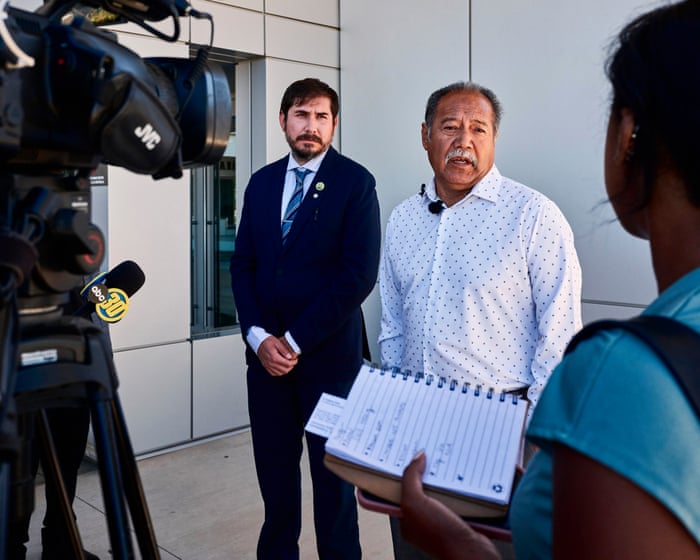
News Summary
The Guardian reports that a recall election in Avenal, California removed local officials and that members of the city council have refused to accept the election results. The article situates the dispute in the small Central Valley city—contrasting the town's "oasis in the sun" image with recent turmoil—and states the episode has attracted attention beyond the region. The supplied excerpt does not include names, vote totals, dates, legal filings, or details about enforcement or responses from county or state authorities.
Source and Framing Analysis
Primary source: The Guardian feature (linked in the supplied package) is the basis for the cluster. The piece frames the event as a local political crisis with broader repercussions, using evocative language to emphasize disruption. In the excerpt supplied, the central factual claim (that recalled officials were removed and that the council refuses to accept the results) is asserted clearly, but the article as supplied omits many routine supporting details (who was recalled, vote tallies, official statements, legal steps taken, and responses by county/state officials). The framing leans toward narrative tension (small-town contrast with national attention). That makes the claim newsworthy, but verification requires additional primary documents or reporting (local election office records, county counsel or sheriff statements, court filings, direct statements from council members or recalled officials).
How sources covered this story
Sanctuary separately assesses reporting quality and alignment with Christian virtues. The virtues assessment considers truthfulness, dignity, compassion, justice, peacemaking, humility, and care for vulnerable people. It does not assess a publisher's faith or reward religious language.
Compare 1 reports
Rank 1
The Guardian: This California town booted out its leaders – what happens if they refuse to leave?Reporting 75/100Virtues 75/100
- Distinctive contribution
- States that the Avenal city council refused to accept the results of a recall election and frames the event as having consequences beyond the local area; contrasts the town's motto with the turmoil to set narrative context.
- Framing
- The excerpt frames the story as a local crisis with broader implications, using evocative language ('rocked') and a contrast between the town's idyllic motto and the political dispute to emphasize disruption.
- Omissions or uncertainty
- The excerpt provides no specifics about timeline (when the recall occurred), which council members refused to accept the results, legal/administrative steps taken, evidence or sources for the claim, perspectives of recalled officials or challengers, or details about the nature of the 'repercussions' mentioned.
- Why these scores
- As a short lede, the excerpt concisely communicates a clear, newsworthy claim and situates it broadly. However, it is light on specifics, attribution, and supporting detail in the supplied text. For an intro paragraph this is acceptable, but the supplied material alone lacks the evidence and sourcing needed for a higher score. The excerpt is neutral in tone, avoids dehumanizing language, and highlights a civic problem that could concern justice and community well-being. It neither exploits suffering nor omits obvious ethical concerns, but the supplied text does not demonstrate explicit compassion, restorative context, or attention to vulnerable parties, so it earns a solid but not exceptional score.
Biblical Reflection
From a Christian perspective, this story raises duties to truth, lawful order, justice, and care for neighbors. Christians should value institutions that protect the vulnerable by ensuring transparent, lawful elections and accountable public service; at the same time the church must insist on justice and hold leaders morally accountable when they breach public trust. The faithful posture is to seek verified facts, avoid celebrating disorder, pursue lawful remedies for enforcing election outcomes, minister pastorally to those harmed or anxious, and work for reconciliation and restoration where possible. This stance balances respect for legitimate authority with prophetic concern for justice and the dignity of all involved.
Scripture in context
- 1Romans 13:1-7 — Instruction in the New Testament about the role of governing authorities and the responsibility of citizens under civil order. — Use this passage to underscore the importance of civic order and lawful processes; it supports seeking lawful avenues to resolve disputes and holding officials accountable through established institutions rather than extra-legal measures.
- 2Matthew 5:9 (Beatitudes) — Jesus' teaching about peacemakers being called blessed. — Encourages Christians to pursue peace and reconciliation amid civic conflict—working to de-escalate tensions and promote procedures that restore community trust.
- 3Micah 6:8 — A prophetic call to act justly, love mercy, and walk humbly with God. — A reminder that public life must be guided by justice and mercy: press for transparency and fair application of the law while caring for those who may be vulnerable in the dispute.
Faithful Response
Prayer for clarity, safety, and wisdom for local officials, election workers, county authorities, and the community.
Seek reliable, primary information before forming conclusions—contact or consult county election records, local clerk statements, or court filings rather than only reading summaries.
Encourage lawful, institutional remedies for enforcing election outcomes (e.g., county certification processes, court review, sheriff or county counsel involvement) and resist calls to extra-legal enforcement or intimidation.
Provide pastoral care to municipal employees, families, and neighbors affected by the dispute; create margin for lament, discourage rumor-spreading, and offer practical help to those feeling threatened.
If congregations host civic information events, invite nonpartisan officials (county elections office, county counsel) and emphasize civic education and reconciliation rather than partisan advocacy.
Reflection and Discussion
- 1What practical steps does our congregation or civic group need to take to encourage a lawful, peaceful transition if election results are being resisted?
- 2How do we hold public officials accountable without contributing to polarization or endangering vulnerable neighbors who may be caught in the dispute?
- 3Where can we offer pastoral presence or practical assistance to people hurt by this civic conflict (city employees, families, voters)?
- 4What local sources (county clerk, election office, county counsel, sheriff) should we consult to get authoritative information before speaking or acting?
Sources
Reporting links are evidence inputs; Sanctuary News' biblical reflection is commentary.
This outlook currently relies on fewer than two linked sources. Broaden verification before teaching from it.
- 1.This California town booted out its leaders – what happens if they refuse to leave?primary_reporting