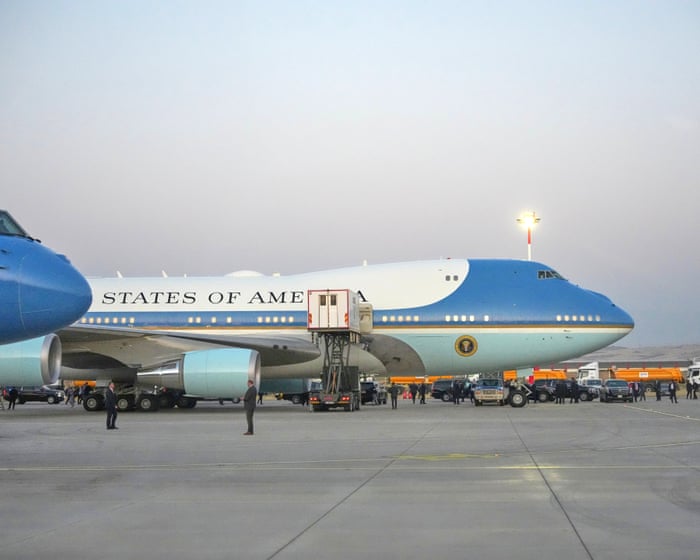
News Summary
Multiple mainstream outlets report that in July, while President Donald Trump departed the NATO summit in Ankara, U.S. media say he was covertly moved from the legacy Air Force One to a smaller military aircraft. The Guardian (summarizing reporting by the Washington Post and the New York Times and citing an unnamed U.S. official) describes an "elaborate ruse" in which the president was publicly shown boarding Air Force One and then reportedly shuttled minutes later—allegedly via an airport catering container/truck—to a different military plane. The BBC corroborates the core claim that the president was moved from the legacy Air Force One to another military aircraft but omits the more graphic operational specifics and the asserted motive. PBS NewsHour published a confirmatory account that repeats the catering‑truck detail and reports the president "switched planes not once, but twice." All detailed operational and motive claims in the public reporting rely on anonymous U.S. officials and secondary U.S. media reporting; no on‑the‑record confirmation from the White House or Department of Defense is present in the supplied material.
Source and Framing Analysis
Reporting pattern: the supplied accounts converge on a core fact—that President Trump was transferred from the legacy Air Force One to another military aircraft while departing a NATO summit in Ankara—but diverge about operational specifics, motive attribution, and the number of transfers. The Guardian (drawing on the Washington Post and the New York Times and an unnamed U.S. official) supplies vivid operational detail (hiding the president in a catering container/truck, boarding in view of cameras then later being shuttled) and frames the transfer as prompted by an alleged Iranian assassination threat. The BBC offers a shorter, cautious corroboration that attributes the claim to U.S. media without the more graphic details or explicit motive. PBS NewsHour confirms the Washington Post reporting and repeats the catering‑truck detail while adding that the president "switched planes not once, but twice." Assessment: all supplied reporting depends substantially on anonymous sources and secondary reporting, which lowers independent verifiability of dramatic operational details. The accounts do not include on‑the‑record official confirmations in the supplied materials. Given the national‑security sensitivity, responsible coverage and public discussion should treat the core movement claim as reported by multiple outlets while treating more specific operational and motive claims as requiring additional, on‑the‑record corroboration or documentary evidence before being accepted as established fact. Where outlets differ is not whether a transfer occurred but in the level of operational specificity, the attribution of motive (an Iranian threat), and ancillary claims such as multiple successive plane switches.
Free every morning
Get the Daily Briefing
The stories shaping today—sourced carefully and considered through Scripture. No outrage bait.
Confirm by email. Unsubscribe at any time.
How sources covered this story
Sanctuary separately assesses reporting quality and alignment with Christian virtues. The virtues assessment considers truthfulness, dignity, compassion, justice, peacemaking, humility, and care for vulnerable people. It does not assess a publisher's faith or reward religious language.
Compare 3 reports
Reporting 78/100Virtues 75/100
- Distinctive contribution
- Affirms independent confirmation of the plane switches (twice) and the previously unreported detail that a catering truck was used to move the president between aircraft.
- Framing
- Authoritative corroboration: presents the verification of another outlet's reporting and emphasizes the novelty of the catering‑truck detail.
- Omissions or uncertainty
- The excerpt does not identify PBS’s sources for the confirmation or explain how the confirmation was obtained; it does not mention the alleged Iranian threat specifics in this text.
- Why these scores
- The excerpt provides clear corroboration of a specific claim and signals verification of another outlet’s report. It is concise and responsibly framed, though the supplied text does not show the underlying sourcing or how PBS verified the Post’s account. The language is factual and non‑sensational, avoids demeaning descriptions, and focuses on verification — showing care for accuracy and not inflaming fear based on the provided excerpt.
Reporting 78/100Virtues 74/100
- Distinctive contribution
- Gives granular operational details (hidden in a catering container, moved from a visible boarding onto a subsequent secret shuttle to a smaller military plane; travel from Turkey to Britain) and attributes the account to named outlets and an unnamed US official.
- Framing
- Presents the event as an “extraordinary ruse” prompted by an Iranian assassination threat and relies on attribution to other major outlets and an unnamed official for credibility.
- Omissions or uncertainty
- Relies on secondary reporting and an unnamed US official in the excerpt; does not include the official’s identity, documentary evidence, or explanation of the threat’s nature or intelligence basis.
- Why these scores
- The excerpt supplies concrete operational detail and cites other reputable outlets and an official source, which strengthens credibility. However, the excerpt shows dependence on unnamed sourcing and secondary reports; naming the official or giving direct sourcing would increase reliability. The passage reports a security‑sensitive episode without sensationalized language, highlights risks to individuals, and credits other outlets and an official rather than making unverified claims. It treats subjects matter‑of‑factly and focuses on public‑interest information.
Reporting 72/100Virtues 72/100
- Distinctive contribution
- Connects the plane‑swap ruse to prior joint US–Israeli strikes (claiming Iran lost top leaders including Khamenei) and frames the operation as evidence that the Iranian threat was credible; flags that people left on the jet might have been targeted.
- Framing
- Frames the ruse as an indicator of the seriousness and credibility of an Iranian assassination threat, using interpretive language and quoted paraphrase of unnamed experts.
- Omissions or uncertainty
- Uses broad references to “experts” without naming them or their evidence; asserts deaths of Iran’s supreme leader and senior officials without sourcing in the excerpt; does not provide operational details or primary-source attribution for the claim that aides/journalists were potential targets.
- Why these scores
- The passage offers useful analytical context and stakes, but in the supplied text it relies on generalized attribution (“experts”) and makes consequential factual claims (e.g., the killing of Iran’s supreme leader and multiple senior officials) without sourcing or named attribution in the excerpt. Responsible framing is present but more specific sourcing would strengthen it. The excerpt treats subjects matter-of-factly without dehumanizing language, highlights risk to non-combatants (aides and journalists), and aims to explain motivations and consequences. It does include vivid claims of killings and revenge but does not exploit or sensationalize victims in the supplied text.
Biblical Reflection
Christian concern holds two goods together: the duty to protect human life (recognizing that prudent, limited secrecy can be morally defensible when lives are at genuine risk) and the duty to seek truthful accountability in a democratic society. Fear and real threats may justify guarded operational secrecy; routine, partisan, or gratuitous secrecy corrodes public trust and harms the common good. Wisdom traditions counsel prudence guided by moral integrity: be shrewd in protection (so as to preserve life) while maintaining honesty, accountability, and care for those harmed by secrecy. Practically: pray for those who bear security burdens, avoid amplifying unverified operational details, advocate for proportionate and lawful oversight, and care pastorally for people unsettled by reports about leadership and safety. The Christian call emphasizes truth, mercy, justice, peacemaking, humility, human dignity, and care for vulnerable neighbors in public life.
Scripture in context
- 1Proverbs 2:6-8 — Wisdom is presented as a gift that guides and protects those who seek it; the passage addresses discernment in ordinary and communal decisions. — Those who decide on protective secrecy should seek prudent counsel and moral wisdom. Secrecy can be justified to protect life, but wisdom requires balancing protection with sustaining public trust and ethical accountability.
- 2Matthew 10:16 — Jesus instructs followers to be prudent in hostile settings while maintaining moral innocence. — Public-security actors may need prudence and caution in the face of threats, yet must not abandon integrity or the duty to be accountable. The Christian ethic calls for both shrewd protection and transparent righteousness where possible.
Faithful Response
Pray specifically for the safety, wisdom, and moral clarity of national leaders, security personnel, and journalists covering sensitive matters.
Avoid sharing or amplifying operational details that rest on anonymous sourcing until corroborated by on‑the‑record confirmation; prioritize verified information over sensationalism.
Advocate for proportionate oversight: request lawful briefings and accountability for extraordinary security measures while recognizing legitimate operational secrecy when lives are at stake.
Care for the vulnerable effects of fear and secrecy—support civic structures that protect citizens and resist narratives that dehumanize political opponents.
Encourage congregations to model humility: ask questions, demand evidence, and refrain from character assassination based on unverified claims.
Free every morning
Get the Daily Briefing
The stories shaping today—sourced carefully and considered through Scripture. No outrage bait.
Confirm by email. Unsubscribe at any time.
Reflection and Discussion
- 1How does the Christian commitment to truth and mercy shape the way we respond to anonymous security reports about leaders’ movements?
- 2When is secrecy morally justified to protect life, and what mechanisms should a democracy use to provide oversight without endangering operations?
- 3How can Christian communities resist the spectacle of fear and instead cultivate trust, charity, and careful civic engagement?
- 4If operational secrecy becomes politically convenient, what steps should citizens and faith communities take to insist on oversight and moral responsibility?
Sources
Reporting links are evidence inputs; Sanctuary News' biblical reflection is commentary.
- 1.Trump reportedly hid in catering container to board secret flight in Turkey amid Iran threatprimary_reporting
- 2.Trump hid in catering truck in secret plane swap over Iran threat, reports sayadditional_reporting