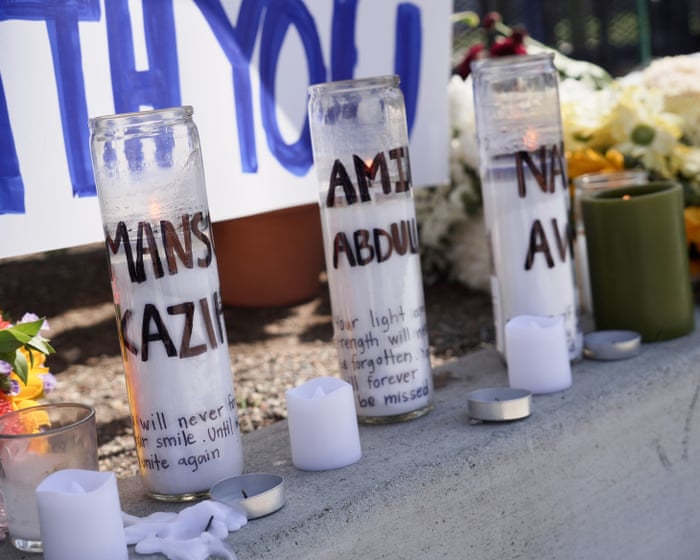
News Summary
Forsyth County (NC) District Attorney Jim O’Neill announced that a 17-year-old girl was arrested and indicted by a grand jury on three counts of murder and one count of conspiracy after he said she recorded a livestream of a shooting that killed three people at a San Diego mosque and disseminated the attackers’ white‑supremacist writings. Her name was not released at the DA’s news conference. Reporting supplied by The Guardian and corroborated in principle by PBS NewsHour attributes the allegations to the DA; neither source published charging documents or detailed evidentiary materials in its coverage.
Source and Framing Analysis
Coverage of this cluster is attribution‑driven and centered on the prosecutorial announcement. The Guardian supplies the most concrete procedural details (identifying Forsyth County DA Jim O’Neill; saying the accused was arrested in Winston‑Salem the prior week; reporting that a grand jury returned an indictment with three murder counts and one conspiracy count; noting the accused’s name was withheld). PBS NewsHour independently corroborates the core prosecutorial claim that a 17‑year‑old recorded the mosque shooting livestream and disseminated the attackers’ white‑supremacist writings and was charged with murder by aiding and abetting. Both outlets frame the story as criminal accountability and emphasize the extremist nature of the attackers’ writings. Major gaps across reporting: no charging documents or indictment text have been published in the cited coverage; no defense or family statements appear; reporters do not explain the evidentiary basis that would connect recording/dissemination to aiding and abetting murder; and the mechanism for a North Carolina prosecution of an incident in San Diego is not detailed. There are no explicit factual contradictions between the cited reports; the remaining differences are omissions and unanswered legal questions rather than direct disputes.
Free every morning
Get the Daily Briefing
The stories shaping today—sourced carefully and considered through Scripture. No outrage bait.
Confirm by email. Unsubscribe at any time.
How sources covered this story
Sanctuary separately assesses reporting quality and alignment with Christian virtues. The virtues assessment considers truthfulness, dignity, compassion, justice, peacemaking, humility, and care for vulnerable people. It does not assess a publisher's faith or reward religious language.
Compare 2 reports
Reporting 82/100Virtues 75/100
- Distinctive contribution
- Identifies Forsyth County DA Jim O’Neill as the source, states the indictment by grand jury (three counts of murder and one of conspiracy), notes the arrest occurred last week and that the name was not released, and situates the DA’s remarks in Winston-Salem at a news conference.
- Framing
- Straightforward criminal-reporting frame: emphasizes the charging decision and formal legal actions, attributes claims to the district attorney, and highlights the girl's role in recording the livestream and disseminating white‑supremacist writings.
- Omissions or uncertainty
- Does not provide the girl's name, specifics of the evidence linking her to aiding/abetting, details about the San Diego attack (victim identities, attackers' status), why a North Carolina DA is prosecuting a San Diego shooting, potential defence statements, or bail/next-court-date information.
- Why these scores
- The excerpt attributes the claims to a named public official (DA Jim O’Neill) and gives concrete legal details (indictment counts, location of news conference), which supports reliability. It is concise and avoids sensationalized language. It loses points for lack of contextual/legal explanation (jurisdiction rationale) and limited detail about evidence or responses from the accused or victims’ families—reasonable limits for a short news item but material to understanding the case. Reporting is factual and non‑dehumanizing, attributes allegations rather than asserting guilt beyond charges, and includes context of extremist writings (important for truthfulness and justice). It shows no gratuitous sensationalism or exploitation of suffering. It does not, however, include apparent efforts to center victim dignity, affected communities, or statements showing compassion or restorative context, which would raise the score further.
Reporting 72/100Virtues 70/100
- Distinctive contribution
- Concise independent confirmation of the central allegation that a North Carolina district attorney charged a 17‑year‑old for recording the livestream and disseminating white‑supremacist writings; it serves as a second-source corroboration.
- Framing
- Concise, neutral news summary focusing on the DA's announcement and the core allegations (recording the livestream and disseminating writings); minimal detail or elaboration.
- Omissions or uncertainty
- Lacks almost all contextual details: no DA name, no indictment counts, no timing or location of the announcement, no information about evidence, victims, attackers, jurisdictional basis, or any response from the accused or others.
- Why these scores
- The excerpt is accurate and attributed to a district attorney; it responsibly states the allegation without sensational language. It is very brief and provides minimal context or detail, which constrains its utility but does not indicate poor reporting quality for a short summary. The excerpt is factual, non‑accusatory beyond reporting charges, and avoids dehumanizing language. It does not include explicit compassion, victim-centered perspective, or restorative context, so it scores as neutrally responsible reporting without evident moral emphasis.
Biblical Reflection
A Christian response to this news must hold truth and mercy together. Truth and justice call for a thorough, evidence‑based legal process that protects worshipping communities harmed by racially motivated violence and seeks accountability for wrongdoing. Mercy and humility require resisting dehumanizing rhetoric about the accused—especially a juvenile—until evidence is publicly established and due process runs its course. Christians should stand in solidarity with victims and vulnerable neighbors, explicitly reject white‑supremacist ideology, and advocate for responses that prioritize safety for survivors while allowing for rehabilitation and restoration where appropriate. Practically, congregations can offer tangible support to affected Muslim communities, press for transparency from authorities about evidentiary bases and jurisdiction, instruct youth about the moral weight and consequences of sharing violent or extremist material online, and explore restorative pathways that center survivors’ safety and community healing.
Scripture in context
- 1Scriptural themes (Isaiah 1:17; Matthew 5:9 referenced as themes) — Themes calling God’s people to seek justice and to be peacemakers within communal life. — These themes counsel action that both protects the vulnerable and pursues reconciliation: support victims and public accountability, while maintaining a posture that allows for repentance, restoration, and the dignity of all persons.
Faithful Response
Pray for the victims’ families, those wounded in the attack, and the Muslim community affected by targeted violence; offer concrete support such as counseling referrals, donations to verified relief efforts, and interfaith solidarity where appropriate.
Speak clearly and consistently against white supremacy and the spread of extremist content that can enable real‑world harm.
Respect the criminal‑justice process and avoid public dehumanization of the accused; press for transparency about evidence and the legal basis for charges—especially when charges hinge on recording or dissemination of violent acts.
Educate and pastorally guide youth and families about the ethical responsibilities of online sharing and the consequences of amplifying violent ideologies; explore restorative‑justice options that prioritize survivor safety and long‑term community healing.
Free every morning
Get the Daily Briefing
The stories shaping today—sourced carefully and considered through Scripture. No outrage bait.
Confirm by email. Unsubscribe at any time.
Reflection and Discussion
- 1How do we balance the Christian commitments to justice for victims and mercy toward those accused, particularly when the accused is a juvenile?
- 2What responsibilities do Christians (parents, teachers, pastors) have in shaping how young people use digital platforms that can amplify violent ideologies?
- 3In what practical ways can congregations stand in solidarity with religious minorities targeted by racialized violence while also honoring due process and the dignity of every person?
Sources
Reporting links are evidence inputs; Sanctuary News' biblical reflection is commentary.
- 1.Teen charged with murder for recording San Diego mosque shooting livestreamprimary_reporting
- 2.Teen who recorded San Diego mosque shooting livestream has been charged with murder, DA saysadditional_reporting