News Summary
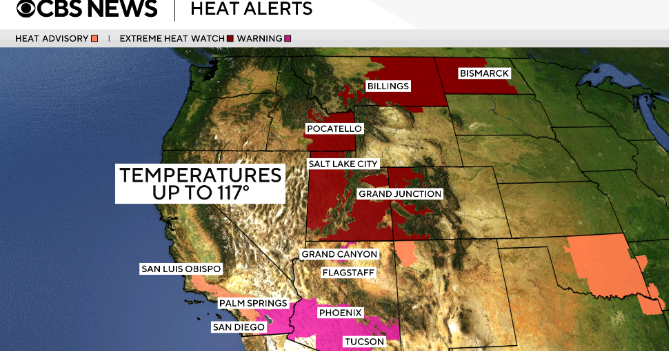
Forecasters warned that an extreme heat event across the western United States could push temperatures as high as 117°F in desert communities such as the Coachella Valley and Palm Springs. Multiple states — including Arizona, Nevada, New Mexico, Texas, Arkansas and Florida — were forecast to see triple-digit or near-triple-digit temperatures through at least the end of the week. Phoenix recorded consecutive days of 113°F and nighttime lows remaining above 90°F, with forecasts indicating possible daytime highs up to 115°F and sustained overnight temperatures above 110°F in the Phoenix area into next week. The National Weather Service issued extreme heat warnings and advisories for millions of people and issued heat watches for parts of Colorado, Montana and the Dakotas as the warmth is expected to spread. Fire weather alerts were also in effect because dry conditions and lightning increase wildfire risk. Local impacts include closed hiking trails, a surge in heat-related emergency calls (about 400 since May 1 reported by the Phoenix Fire Department), use of cold-water immersion for heat-stroke victims, and 18 heat-related deaths in the Phoenix area so far this year, compared with five by this time last year. Forecasters warned that heat indices in parts of the Southeast could reach 113–116°F when humidity is included.
Biblical Reflection
The report is straightforward in relaying immediate facts and official warnings from the National Weather Service and local authorities; its core truth claim — that extreme heat is occurring and posing acute dangers — is well supported by reported temperatures, emergency responses, and death counts. The coverage is oriented to public safety rather than long-term causes or policy responses, so readers should note what's included (warnings, impacts, responder actions) and what is not emphasized (broader climate trends, infrastructure failures, or populations disproportionately affected). From a Christian perspective, the story calls for compassionate, practical responses rooted in mercy and neighbour-love: prioritize care for the elderly, outdoor workers, unhoused people, and others whose vulnerability is amplified by heat; support emergency responders who work under strain; and pursue wise stewardship of creation by acknowledging how human activity and community planning shape vulnerability. The article’s framing is largely neutral and serviceable for urgent safety needs, but Christians should also ask deeper questions about justice and stewardship — who bears the greatest burden, and what communal policies and habits reflect love of neighbour and responsible care for God’s world.
Scripture in context
This outlook does not yet include contextual Scripture citations. Do not treat a general biblical theme as an exegetical conclusion.
Faithful Response
No prescribed response is offered. Consider the reflection prompts below in your own church context.
Reflection and Discussion
- 1Whose voices and experiences are missing from the coverage — for example, seasonal workers, the unhoused, or low‑income households without reliable cooling?
- 2Does the article frame heat as an isolated weather event or as part of broader patterns that call for communal planning and stewardship?
- 3How does emphasis on immediate emergencies shape public perception of responsibility — individual survival, government action, or collective care?
Sources
Reporting links are evidence inputs; Sanctuary News' biblical reflection is commentary.
This outlook currently relies on fewer than two linked sources. Broaden verification before teaching from it.
- 1.Original reportprimary