News Summary
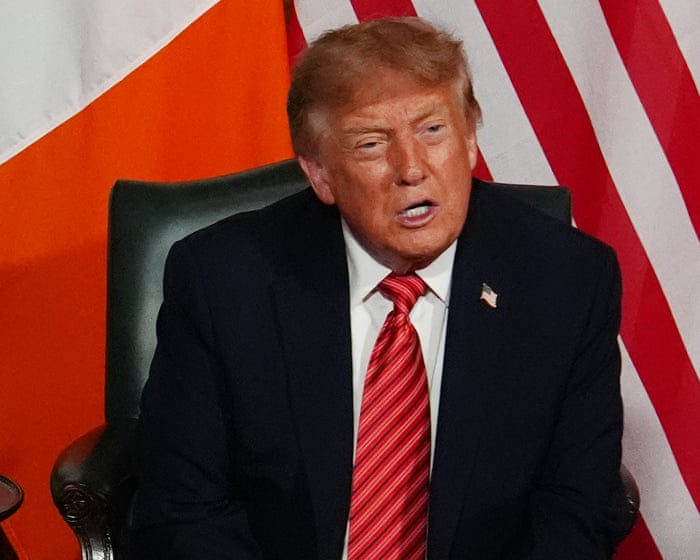
During a two-day visit to the Republic of Ireland, President Donald Trump was reported to have said he would “love” to see a united Ireland and that it “may as well happen now.” The visit included meetings with Irish leaders and attendance at the Irish Open; reporting notes the tournament took place at a course the president owns. The Guardian reports the comment prompted swift rebuttals from the UK government and Northern Ireland’s unionist leaders. Precise wording, full context, and whether the remark represents a deliberate policy position remain unclear in the available accounts.
Source and Framing Analysis
The Guardian supplies the direct quoted language attributed to the president and emphasizes the political sensitivity of the statement, noting immediate pushback from the UK government and unionist leaders; this frames the comment as a potentially political intervention. CBS corroborates the visit details and supplies an optics-related detail — that the Irish Open was held at a course owned by the president — but its supplied excerpt does not reproduce the full quote or the reported reactions. Key uncertainties arise from the lack of a full transcript, the absence of on-the-record, time-stamped rebuttal texts in the supplied excerpts, and limited context about to whom and in what setting the remark was made. Framing differences: The Guardian presents the remark as an unexpected intervention with political consequences; CBS highlights the mixed official/personal nature of the trip (meetings plus attendance at an event on property he owns) without foregrounding controversy. Both pieces are useful: Guardian for the quote and reported reactions; CBS for visit logistics and optics. Neither source supplies a complete on-the-record transcript or clarifying statement from the president that would resolve whether the remark was rhetorical or an intended policy signal.
Free every morning
Get the Daily Briefing
The stories shaping today—sourced carefully and considered through Scripture. No outrage bait.
Confirm by email. Unsubscribe at any time.
How sources covered this story
Sanctuary separately assesses reporting quality and alignment with Christian virtues. The virtues assessment considers truthfulness, dignity, compassion, justice, peacemaking, humility, and care for vulnerable people. It does not assess a publisher's faith or reward religious language.
Compare 2 reports
Reporting 78/100Virtues 75/100
- Distinctive contribution
- Provides the president's quoted language ('would “love” to see a united Ireland' and 'may as well happen now'), situates the remark at the start of a two-day Ireland visit, and reports that it prompted swift rebuttals from the UK government and Northern Ireland unionist leaders.
- Framing
- Straight news framing with a focus on the surprise or unexpected nature of the intervention; presents the quote and immediate political reactions without apparent editorializing beyond the word 'unexpected'.
- Omissions or uncertainty
- No full context for the quote (who he was speaking to, full transcript, whether it was rhetorical), absence of direct quotes or responses from the UK government or unionist leaders, no date/time beyond 'start of a two-day visit', and no sourcing or attribution for the reaction claims in the excerpt.
- Why these scores
- The excerpt conveys a clear, specific quote and notes immediate political pushback, which is appropriate for brief news copy. It is concise and relevant. It lacks fuller contextual detail and sourcing in the excerpt (full context of the remark, verbatim responses), but for a short item it responsibly highlights the main facts and the political consequences. The excerpt is neutral in tone and avoids dehumanizing language; it reports a political statement and notes responses, supporting truthful and respectful coverage. It does not explicitly emphasize compassion, justice, or care for vulnerable parties, but it avoids sensationalism and presents disagreement, so it aligns reasonably well with virtues of truthfulness and respect.
Reporting 74/100Virtues 72/100
- Distinctive contribution
- Notes the mixed nature of the visit (official talks plus attendance at a sporting event) and explicitly states the golf course where the Irish Open is held is owned by the president, which adds a potential conflict-of-interest/optics dimension not present in the other excerpt.
- Framing
- Factual, concise framing emphasizing the combination of official duties and personal/business-linked activity (attending an event at his own golf course).
- Omissions or uncertainty
- Does not quote the president on the Ireland-unification remark, omits any mention of reactions or controversy, lacks timing/context for the meetings or Irish Open attendance, and offers no sourcing or detail about the ownership claim beyond the single line.
- Why these scores
- The excerpt is a succinct, factual line that highlights a concrete and relevant detail (attendance at an event on property he owns). For a brief lead or summary sentence it responsibly identifies a noteworthy fact; however, it lacks supporting detail, attribution, and broader context in the supplied text. The line is neutral and non-inflammatory; it draws attention to a fact (ownership) that could bear on fairness and stewardship without sensational language. It neither exploits suffering nor dehumanizes subjects, aligning moderately well with truthfulness and justice-related virtues.
Biblical Reflection
As Christians, we should notice both the human tendency to speak plainly about moral or political hopes and the responsibility leaders carry when speaking about contested national questions. The president’s words express a personal preference but touch a fragile history in Northern Ireland where identity, sovereignty, and memory remain raw. Public statements by high-profile foreign leaders can unintentionally intensify fears or give political ammunition to one side or another, even when framed as personal wishes. Truth demands that we distinguish a personal expression of hope from an authoritative policy commitment; mercy and peacemaking call us to weigh how speech affects vulnerable neighbors. The Christian response is neither reflexive cheerleading nor partisan dismissal: it is a careful commitment to truth-telling, to seeking the flourishing and safety of communities on both sides of an issue, and to honoring legitimate democratic and legal processes that govern constitutional change. Christians should pray for peace, encourage responsible leadership, and work to foster dialogue that prioritizes reconciliation over provocation.
Scripture in context
- 1Matthew 5:9 — In the Sermon on the Mount, Jesus teaches about the character of those who belong to his kingdom; being a 'peacemaker' is presented as a virtue that aligns believers with God’s restorative purposes in human relationships. — This passage calls Christians to pursue reconciliation and seek the welfare of divided communities, prompting caution when public speech risks escalating conflict rather than building peace.
- 2James 3:1-12 — James warns about the power of the tongue and how small speech can have large consequences, particularly for those in positions of authority and influence. — The teaching urges leaders and listeners alike to exercise restraint and care in speech, recognizing that casual comments can inflame tensions and that responsible use of words is part of faithful leadership.
Faithful Response
Pray specifically for people in Northern Ireland, for Irish and UK leaders, and for those most vulnerable to renewed tensions.
Distinguish between a leader’s personal expression and an official policy commitment; avoid amplifying statements in ways that could inflame identity-based tensions.
Learn the historical and political background of Northern Ireland’s constitutional arrangements before taking or publicizing strong positions.
Prioritize listening to people from the affected communities—especially those with lived experience—and center their safety and flourishing in any public or private response.
Encourage and support lawful, democratic, and locally led processes for constitutional change while advocating for safeguards that protect minority rights and peace agreements.
Free every morning
Get the Daily Briefing
The stories shaping today—sourced carefully and considered through Scripture. No outrage bait.
Confirm by email. Unsubscribe at any time.
Reflection and Discussion
- 1What responsibility do Christians have to weigh the likely real-world effects of political speech on vulnerable communities?
- 2How does the call to be peacemakers shape our response when leaders' words risk deepening historical divisions?
- 3In what ways should our commitment to justice be informed by prudence, humility, and care for neighbors directly affected by political change?
Sources
Reporting links are evidence inputs; Sanctuary News' biblical reflection is commentary.
- 1.Trump says he would "love" a unified Ireland as he kicks off visitadditional_reporting
- 2.Donald Trump says he would ‘love’ to see united Irelandprimary_reporting