News Summary
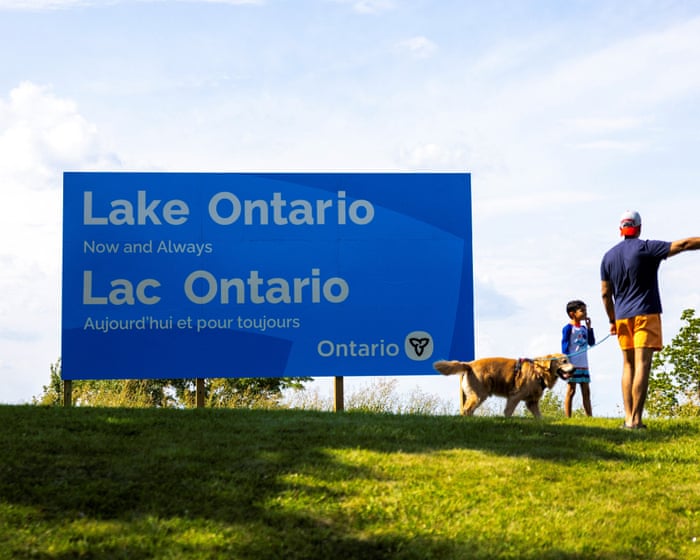
Canada erected a very large sign that reads “Lake Ontario. Now and Always.” PBS NewsHour reports the sign measures 24-by-12 feet, sits on 6-foot legs, and its top is about 18 feet above the ground. The Guardian reports that U.S. President Donald Trump posted a video in which he appears to topple an avatar of a Lake Ontario sign, replace it with one reading “Lake America,” and dance to YMCA. The Guardian frames the naming spat as the public face of an escalating trade dispute between the U.S. and Canada and mentions a reported 50% U.S. tariff on Canadian steel and Canadian retaliatory tariffs; the supplied reporting does not include the primary government documents or legal texts that would confirm the administrative renaming or the exact tariff authorities.
Source and Framing Analysis
Two supplied sources contribute distinct material and different framings. PBS NewsHour provides neutral, verifiable physical details about the sign (24-by-12 feet on 6-foot legs, top about 18 feet high), which grounds the report in concrete observation. The Guardian supplies narrative context and political color: it reports President Trump’s posted video depicting him toppling and replacing a sign and links the naming exchange to a broader trade dispute, including an asserted 50% U.S. steel tariff and retaliatory Canadian measures. The Guardian’s framing emphasizes spectacle and confrontation; PBS focuses on descriptive fact. Material uncertainties and attribution gaps remain: the Guardian’s claims about an “administrative renaming” and the stated tariff percentage are not supported in the supplied excerpts by primary government documents or legal citations, and provenance details for the posted video (platform, timestamp, official confirmations) are not provided in the supplied texts. Readers should treat the physical details as strongly supported (PBS) and treat policy/legal claims as reported but insufficiently documented in the supplied material (Guardian).
Free every morning
Get the Daily Briefing
The stories shaping today—sourced carefully and considered through Scripture. No outrage bait.
Confirm by email. Unsubscribe at any time.
How sources covered this story
Sanctuary separately assesses reporting quality and alignment with Christian virtues. The virtues assessment considers truthfulness, dignity, compassion, justice, peacemaking, humility, and care for vulnerable people. It does not assess a publisher's faith or reward religious language.
Compare 2 reports
Reporting 78/100Virtues 70/100
- Distinctive contribution
- Gives exact dimensions (24-by-12-foot) and mounting (6-foot legs, top about 18 feet above ground), allowing a clear sense of the sign's size and visibility.
- Framing
- Neutral, descriptive — focuses on concrete physical attributes without editorializing.
- Omissions or uncertainty
- Only the sign's measurements are supplied; the excerpt does not say who erected the sign, when or where it was placed, the sign's text beyond the article title, or any political/contextual framing.
- Why these scores
- The factual detail is specific and verifiable and uses clear, unambiguous language. Because the supplied text is a brief factual description, there is limited attribution or broader context in the excerpt; nonetheless it fulfills its apparent purpose (describing the sign) responsibly. Neutral, factual reporting that does not dehumanize or sensationalize. The excerpt neither advances nor undermines dignity, compassion, or justice; it simply describes a physical object accurately.
Reporting 75/100Virtues 68/100
- Distinctive contribution
- Reports Trump's posted video depicting him tearing down/ replacing a sign and adds that the naming dispute is 'the public face of an escalating trade dispute' involving a large steel tariff and Canadian retaliatory tariffs.
- Framing
- Framed as an escalating, bilateral confrontation — uses language like 'verbal duel' and ties symbolic actions to concrete trade measures, presenting the naming spat as part of a larger geopolitical/economic dispute.
- Omissions or uncertainty
- The excerpt does not provide dates, exact sourcing for the video (e.g., platform, timestamp), independent corroboration of the video's provenance, details of the tariff measures beyond a percentage, nor statements from the involved governments. It is unclear whether the '50% tariff' and 'retaliatory tariffs' are described precisely or summarized.
- Why these scores
- The excerpt delivers notable factual claims and useful context. It clearly links symbolic political theater to policy-level actions, which is valuable. The passage, however, is summary-level and omits sourcing and specific timeline details in the supplied text, limiting full assessment of attribution and verification. The excerpt mostly reports actions and political context without dehumanizing language. The framing emphasizes confrontation and spectacle, which is accurate to the events described but does not particularly foreground compassion, reconciliation, or the human effects of policy; thus it scores slightly below a neutral midline that would emphasize dignity and justice more directly.
Biblical Reflection
Symbols and stunts can crystallize deeper policy disagreements, but Christians should resist letting theatrical gestures substitute for sober neighborly stewardship. The spectacle of signs and viral videos may appeal to tribal loyalties, yet the real consequences—tariffs, supply-chain disruptions, lost jobs, and stressed families—are concrete and human. Christian response centers on truth-telling paired with mercy: seek accurate information about the policy at stake, speak with humility rather than humiliation, advocate for fair negotiation over escalation, and prioritize care for vulnerable neighbors harmed by economic retaliation. Peacemaking requires resisting dehumanizing rhetoric, calling leaders to responsible conduct, and offering practical support to workers and communities affected by the dispute.
Scripture in context
- 1Matthew 5:9 — Jesus’ teaching that peacemakers are called blessed and that the kingdom’s ethics prioritize reconciliation over domination. — This passage invites Christians to press for negotiation and repair amid international quarrels, valuing relationships and the common good above symbolic victory.
- 2Ephesians 4:15 — Paul’s call to speak the truth in love so the community may grow in maturity and unity. — It cautions Christians against public speech that humiliates for spectacle; truthful critique should be framed in love and aimed at constructive outcomes, not merely shaming.
Faithful Response
Pray specifically for leaders on both sides, for those whose livelihoods may be affected by tariffs or retaliation, and for calm, wise negotiation.
Seek reliable, primary-source information about the alleged administrative renaming and tariff measures before drawing policy conclusions or amplifying claims.
Speak and post with restraint: avoid sharing demeaning or inflammatory content and encourage conversation that favors negotiation and mutual respect.
Support local workers, families, and small businesses likely to be harmed by trade escalation through practical assistance, referrals, or charitable resources.
Church leaders can host informational sessions about how trade disputes affect the local economy and lead nonpartisan prayer and service efforts for those under economic stress.
Free every morning
Get the Daily Briefing
The stories shaping today—sourced carefully and considered through Scripture. No outrage bait.
Confirm by email. Unsubscribe at any time.
Reflection and Discussion
- 1How should the call to be peacemakers shape our response to performative nationalistic acts by political leaders?
- 2Which neighbors—workers, families, small businesses—are most likely to suffer from trade escalation, and how should that shape our priorities?
- 3When public leaders use symbolic gestures, how should Christians weigh symbolism against real-world consequences for vulnerable people?
- 4What concrete steps can my congregation take this week to help those locally affected by cross-border economic tensions?
Sources
Reporting links are evidence inputs; Sanctuary News' biblical reflection is commentary.
- 1.Canada erects giant ‘Lake Ontario’ sign as spat with Trump over name escalatesprimary_reporting
- 2.Ontario premier answers Trump's 'Lake America' with giant 'Lake Ontario' signadditional_reporting